Who knows where England's only curling rink is? We do - it is near Tunbridge Wells in Kent! And on 2 December 2017 a representative team from RSC Belgium went "Curling in Kent" with members of the RSC Kent local section at their annual curling event.
The venue was Fenton's curling rink near Tunbridge Wells in Kent and the RSC team (pictured below) consisted of section chairman Tim Reynolds, recent ex-section secretary Becki Scott (now a resident of Kent), Helen Lee (Mrs Chairman) and two locally recruited 'ringers' (friends of the chairman) Sally Wellsteed and Richard Hucker.
The venue was cunningly concealed deep in the Kentish countryside but was eventually tracked down just in time for a hot lunch of lasagna followed by two hours of curling.
Curling has been an Olympic Winter sport since 1988 and is one of the few events everyone can try. It is fair to say that curling is a game that is easy to play, but may take several lifetimes to master... however it was great fun and RSC Belgium aims to return in 2018.
The game is suitable for young and old, and can be played as a social or competitive sport. As England's only dedicated ice curling rink, Fenton’s offers a unique opportunity for people to give curling a go or just meet up for some fun. And there was very little sliping over thanks to the special 'sticky' shoes supplied by the venue.
Warm welcome
The Kent section have been organising a curling event for a few years now and the main protagonist, Dave Alker (pictured left, below), clearly saw the 2017 edition as a great opportunity to practice for the 2018 winter Olympics in South Korea.
This years' participants were a mixture of ‘regulars’ i.e. those who had embarrassed themselves on the rink in previous years, and newcomers. The participants ranged from 18 to 80 and included members, guests and partners as well as RSC staff member Stephanie Comte from the Networks team in Cambridge (pictured above with Tim Reynolds) and, of course, our Belgian contingent. Everyone thoroughly enjoyed the experience.
Dave and the Kent section are working for the 2018 event that will take place on 8 December 2018 at Fenton's. See you there?
Thursday, 1 February 2018
Jessica: our Third Norman Lloyd Scholar
Jessica Powell, the third recipient of the Dr Norman C. Lloyd Scholarship at Cardiff University, has finished her first year at the university in 2017. Jessica (pictured below), who hails from Llandovery, was interviewed by Cardiff University’s Development and Alumni Relations office at the end of the year.
What degree are you undertaking and why did you choose the course here?
I am currently undertaking a masters in chemistry at Cardiff University, I chose the course here because of the high-level facilities and teaching available.
What’s the best thing about studying at Cardiff?
The best thing about studying in Cardiff is all of the opportunities that are made available to you throughout your degree, which allow you to broaden your knowledge and build skills that will be useful in the future.
Do you have a particular career in mind after you graduate?
After I finish my degree in Cardiff I am hoping to join the army as an officer, where I know that the analytical, problem solving and presentation skills, which I have developed during my degree will be of great use to me.
What’s was your favourite module during your first year of study?
During my first year of study my favourite module was the foundations of physical chemistry, the module presented the key mathematical and physical background to explain the fundamentals of physical chemistry.
Do you have any hobbies outside of studying?
Outside of studying I play netball for the chemistry netball team in the IMG league, and I also take part in rifle shooting, in which I competed at a national level, representing Wales at a senior level over the summer.
What difference has this scholarship made to you?
The scholarship has allowed me to gain access to a wider range of textbooks and resources which helped me greatly during my first year, and will continue to assist my studies during the remainder of my course.
If you could say something to the donor who gave you this gift, what would it be?
I would like to thank the family of Dr Lloyd and the Royal Society of Chemistry in Belgium for this scholarship, it allowed me to excel in my first year of studying chemistry at Cardiff university, and further allowed me to gain a more in depth knowledge of all aspects of this course.
We wish Jessica all the best for the future and every success in her future studies at Cardiff.
The scholarship
The Norman Lloyd scholarship was set up by RSC Belgium in collaboration with Norman’s family and Cardiff University in memory of our old friend and supporter Norman Lloyd. Norman was himself a student at an institution that is now part of the university. The funds raised provide an annual scholarship of £1,000 for an undergraduate student, usually in their first year of study. The scholarship is given to new students to the Cardiff School of Chemistry who are of high academic standing and a resident of Wales. The next Norman C Lloyd scholar will be selected in October.
If you would like to donate to the Norman Lloyd scholarship fund follow this link and specify that you wish to donate to the Norman Lloyd Scholarship fund in the comments box
What degree are you undertaking and why did you choose the course here?
I am currently undertaking a masters in chemistry at Cardiff University, I chose the course here because of the high-level facilities and teaching available.
What’s the best thing about studying at Cardiff?
The best thing about studying in Cardiff is all of the opportunities that are made available to you throughout your degree, which allow you to broaden your knowledge and build skills that will be useful in the future.
Do you have a particular career in mind after you graduate?
After I finish my degree in Cardiff I am hoping to join the army as an officer, where I know that the analytical, problem solving and presentation skills, which I have developed during my degree will be of great use to me.
What’s was your favourite module during your first year of study?
During my first year of study my favourite module was the foundations of physical chemistry, the module presented the key mathematical and physical background to explain the fundamentals of physical chemistry.
Do you have any hobbies outside of studying?
Outside of studying I play netball for the chemistry netball team in the IMG league, and I also take part in rifle shooting, in which I competed at a national level, representing Wales at a senior level over the summer.
What difference has this scholarship made to you?
The scholarship has allowed me to gain access to a wider range of textbooks and resources which helped me greatly during my first year, and will continue to assist my studies during the remainder of my course.
If you could say something to the donor who gave you this gift, what would it be?
I would like to thank the family of Dr Lloyd and the Royal Society of Chemistry in Belgium for this scholarship, it allowed me to excel in my first year of studying chemistry at Cardiff university, and further allowed me to gain a more in depth knowledge of all aspects of this course.
We wish Jessica all the best for the future and every success in her future studies at Cardiff.
The scholarship
The Norman Lloyd scholarship was set up by RSC Belgium in collaboration with Norman’s family and Cardiff University in memory of our old friend and supporter Norman Lloyd. Norman was himself a student at an institution that is now part of the university. The funds raised provide an annual scholarship of £1,000 for an undergraduate student, usually in their first year of study. The scholarship is given to new students to the Cardiff School of Chemistry who are of high academic standing and a resident of Wales. The next Norman C Lloyd scholar will be selected in October.
If you would like to donate to the Norman Lloyd scholarship fund follow this link and specify that you wish to donate to the Norman Lloyd Scholarship fund in the comments box
Fourth Norman Lloyd Scholar announced
RSC Belgium is proud to announce that the fourth recipient of the Dr Norman C. Lloyd Scholarship at Cardiff University has been selected and is enjoying their first year at the university. Ffion Cartwright is from Llandovery and started her MCheM degree in Chemistry at the end of September.
Pictured below, Ffion originates from the small village of Mold in North East Wales, but is enjoying living and studying in the Welsh capital. She received the highest A Level scores of her cohort. The scholarship is given to new students to the Cardiff School of Chemistry who are of high academic standing and a resident of Wales.
In a letter thanking the section for sponsoring her award Ffion wrote:
"I would like to thank the Royal Society of Chemistry Belgium and all of Dr Lloyd’s family and friends for awarding me this generous gift.
It is a great honour to now be associated with Dr Lloyd, he had accomplished so many things in his time as a chemist in Barry, Cardiff, Michigan and Brussels. I have been very inspired by his story.
To be awarded this scholarship in his memory has made me feel so proud and has given me even more drive to do well in my degree. So, I intend to use the money on resources and textbooks which will greatly help my studies.
I am originally from a small village in North East Wales so the change to living in a city so far from home has been very daunting, but I have settled in well. I have lived in Wales all my life, so I have a great affinity towards my country, which is the main reason why I chose Cardiff for my place of study. Also, studying in Cardiff has given me the chance to continue my studies of the Welsh language. I have learnt Welsh from a very young age up to A level standard and did not want to lose the opportunity to use the language.
I decided I wanted to pursue a career in chemistry four years ago, as I enjoyed chemistry in school and had been inspired by the life of Marie Curie to study science. My love of chemistry is only growing through my studies and I am enjoying my degree immensely.
I would like to reiterate my thanks to all that have contributed toward the scholarship and those who have chosen me to be receive it, it means a lot to be recognised in this way and I am very grateful for this opportunity."
We all wish Ffion every success in her studies at Cardiff.
Pictured below, Ffion originates from the small village of Mold in North East Wales, but is enjoying living and studying in the Welsh capital. She received the highest A Level scores of her cohort. The scholarship is given to new students to the Cardiff School of Chemistry who are of high academic standing and a resident of Wales.
In a letter thanking the section for sponsoring her award Ffion wrote:
"I would like to thank the Royal Society of Chemistry Belgium and all of Dr Lloyd’s family and friends for awarding me this generous gift.
It is a great honour to now be associated with Dr Lloyd, he had accomplished so many things in his time as a chemist in Barry, Cardiff, Michigan and Brussels. I have been very inspired by his story.
To be awarded this scholarship in his memory has made me feel so proud and has given me even more drive to do well in my degree. So, I intend to use the money on resources and textbooks which will greatly help my studies.
I am originally from a small village in North East Wales so the change to living in a city so far from home has been very daunting, but I have settled in well. I have lived in Wales all my life, so I have a great affinity towards my country, which is the main reason why I chose Cardiff for my place of study. Also, studying in Cardiff has given me the chance to continue my studies of the Welsh language. I have learnt Welsh from a very young age up to A level standard and did not want to lose the opportunity to use the language.
I decided I wanted to pursue a career in chemistry four years ago, as I enjoyed chemistry in school and had been inspired by the life of Marie Curie to study science. My love of chemistry is only growing through my studies and I am enjoying my degree immensely.
I would like to reiterate my thanks to all that have contributed toward the scholarship and those who have chosen me to be receive it, it means a lot to be recognised in this way and I am very grateful for this opportunity."
We all wish Ffion every success in her studies at Cardiff.
The scholarship
The Norman Lloyd scholarship was set up by RSC Belgium in collaboration with Norman’s family and Cardiff University in memory of our old friend and supporter Norman Lloyd. Norman was himself a student at an institution that is now part of the university. The funds raised provide an annual scholarship of £1,000 for an undergraduate student, usually in their first year of study, at the Cardiff School of Chemistry.
If you would like to donate to the Norman Lloyd scholarship fund, please contact the RSC Belgium secretary.
Monday, 4 December 2017
2018 Belgium Top of The Bench results
Our annual 'international eliminator' for the Royal Society of Chemistry's Top of the Bench (ToTB) competition was held at the British School of Brussels (BSB) on Saturday 18 November 2017 with ten teams from six schools taking part. An exciting afternoon of chemical problem solving ended with the announcement of the 2017 winner of the Keith Price Cup: Team Selenium from BSB. They will now represent RSC Belgium at the TOTB grand final in the UK in 2018.
As ever our TOTB eliminator was a close run competition with only a few marks between the top four teams on the individual written quiz components and five out of the ten competing teams correctly classifying the three mystery solutions in our 'Can you tell your acid from your alkali' practical challenge.
Wining formula
The teams completed individual written question papers and then enjoyed a challenging team Practical Problem Solving Exercise. As usual both the 'hands-on' practical and the paper-based component were developed by our resident competition guru, Rita Woodward. The competition was designed to really test the teams’ chemistry knowledge and problem-solving abilities and (hopefully) encourage young talented chemical scientists to consider further education and careers in Chemistry.
The individual scores from the written paper were added together for each team with the placings from the practical to give an overall score with BSB team Selenium coming out on top just a head of Team Vanadium from St. Johns International School (St John’s) in second place and Team Strontium from European School Brussels 2 (EEB 2).
Members of the winning team (pictured below with Rita) each received a RSC heat sensitive mug and the school will hold the TOTB Keith Price Cup during 2018. All the student participants will receive a certificate.
Our huge thanks to all the teachers and other volunteers involved to prepare and organise the event, in particular William Darnley and Luke Stagno Navarra from BSB, and, of course, Rita.
The full line up of participating teams for the 2018 competition was:
Cadmium - British School of Brussels (Tervuren)
Calcium - International School of Flanders (Rhode St Genese)
Krypton - International School of Flanders (Rhode St Genese)
Mercury - European School Brussels 3 (Ixelles)
Nickel - European School Brussels 2 (Woluwe)
Rubidium - European School Brussels 4 (Laeken)
Selenium - British School of Brussels (Tervuren)
Strontium - European School Brussels 2 (Woluwe)
Tellurium - European School Brussels 4 (Laeken)
Vanadium - St Johns International School (Waterloo)
The TOTB Finals will take place in the UK on Saturday 3 March 2018 at Birmingham University (TBC) and RSC sponsors the travel arrangements for our winning team. The RSC Belgium team is usually the only competing school team not based in the British Isles.
Our next TOTB Eliminator Round will take place in Q4 2018. Get your school involved!
As ever our TOTB eliminator was a close run competition with only a few marks between the top four teams on the individual written quiz components and five out of the ten competing teams correctly classifying the three mystery solutions in our 'Can you tell your acid from your alkali' practical challenge.
Wining formula
The teams completed individual written question papers and then enjoyed a challenging team Practical Problem Solving Exercise. As usual both the 'hands-on' practical and the paper-based component were developed by our resident competition guru, Rita Woodward. The competition was designed to really test the teams’ chemistry knowledge and problem-solving abilities and (hopefully) encourage young talented chemical scientists to consider further education and careers in Chemistry.
The individual scores from the written paper were added together for each team with the placings from the practical to give an overall score with BSB team Selenium coming out on top just a head of Team Vanadium from St. Johns International School (St John’s) in second place and Team Strontium from European School Brussels 2 (EEB 2).
Members of the winning team (pictured below with Rita) each received a RSC heat sensitive mug and the school will hold the TOTB Keith Price Cup during 2018. All the student participants will receive a certificate.
Our huge thanks to all the teachers and other volunteers involved to prepare and organise the event, in particular William Darnley and Luke Stagno Navarra from BSB, and, of course, Rita.
Cadmium - British School of Brussels (Tervuren)
Calcium - International School of Flanders (Rhode St Genese)
Krypton - International School of Flanders (Rhode St Genese)
Mercury - European School Brussels 3 (Ixelles)
Nickel - European School Brussels 2 (Woluwe)
Rubidium - European School Brussels 4 (Laeken)
Selenium - British School of Brussels (Tervuren)
Strontium - European School Brussels 2 (Woluwe)
Tellurium - European School Brussels 4 (Laeken)
Vanadium - St Johns International School (Waterloo)
The TOTB Finals will take place in the UK on Saturday 3 March 2018 at Birmingham University (TBC) and RSC sponsors the travel arrangements for our winning team. The RSC Belgium team is usually the only competing school team not based in the British Isles.
Our next TOTB Eliminator Round will take place in Q4 2018. Get your school involved!
Wednesday, 15 November 2017
2017 Chemistry Challenge Winners announced
The results of the RSC Belgium Chemistry Challenge 2017 were announced and the talented prize winners picked up their winnings at a special RSC Belgium event with Dr Matthew Andrews of NATO on the evening of 27 September at the British School of Brussels (BSB). We once again received over 100 entries from international and European schools in Brussels and beyond for this testing challenge of young people's chemical knowledge and initiative.
The RSC Belgium Chemical Challenge has three sections:
- A/ A chemistry multiple choice paper
- B/ A structured questions on chemistry, and
- C/ A 'Thinking Matters' paper that is not chemistry based
And the top results were as follows:
Section A: Multiple choice
First place was shared by Jakob Bull and Tom Valenduc from BSB. Second place was a three-way tie with the prizewinners being Caroline Di Vittorio from the International School of Brussels (ISB) and Caio Hansen and Vrushal Mody, both from BSB. Third place was awarded to James Tissot of ISB.
Section B: Structured Questions
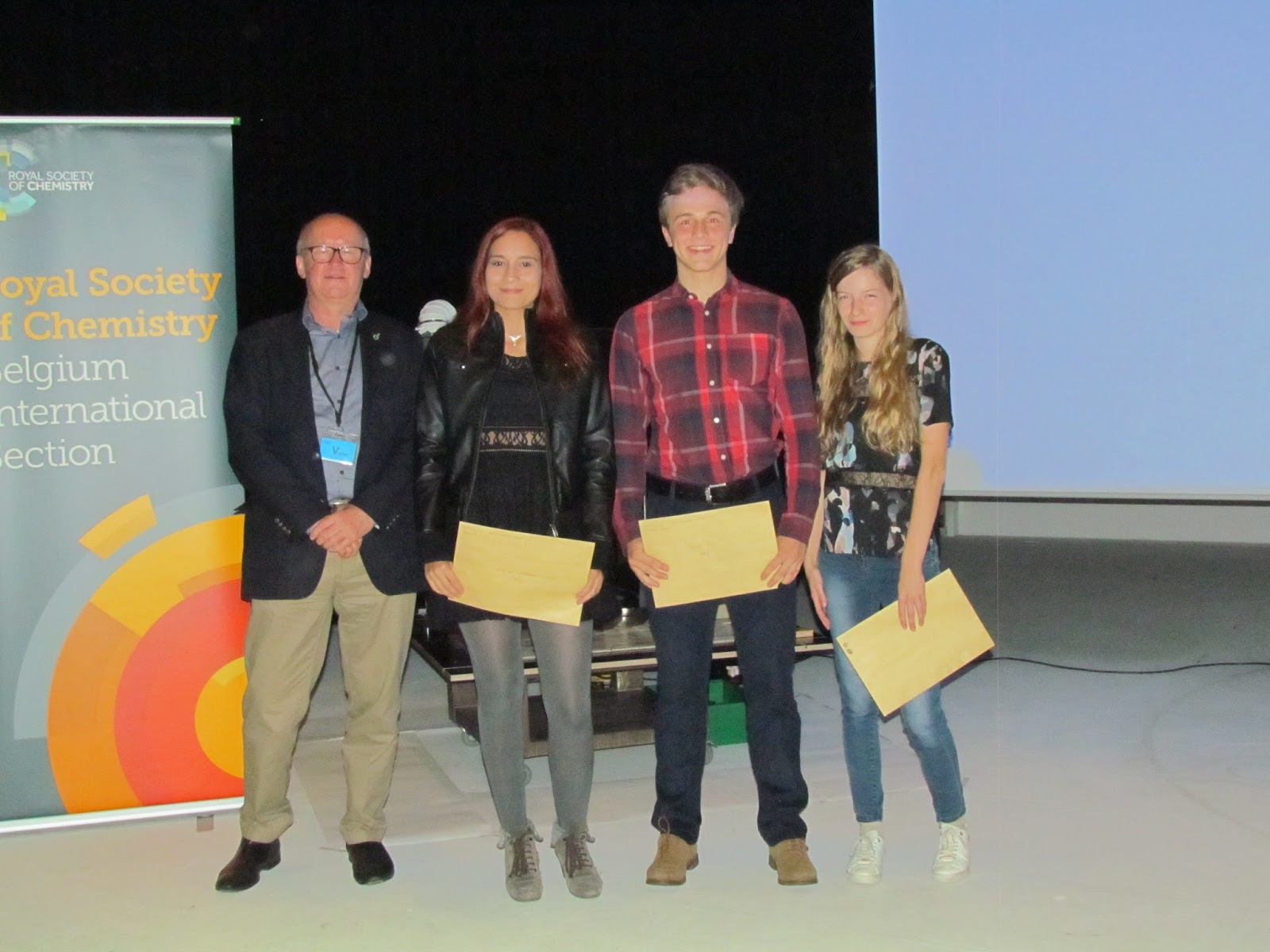
In this section first prize was awarded to Aleksander Ziolkowski from St Johns International School (St. Johns) and second prize was claimed by Nekane Medrano Cuetos of ISB. Third prize was shared by Jakob Bull and Emma Brown, both of BSB. Some of the prizewinners are pictured above with RSC Belgium Chairman Tim Reynolds.
Section C: Thinking Matters
Here first place was awarded to Gabriela van Bergen from BSB (now in Madrid), with a tie for second place between Medhir Dillum and Vrushal Mody, both also from BSB. Leo Sheils from Antwerp International School (AIS) took third prize.
Keith Price Prize
Keith Price Prize
Jakob Bull of BSB, pictured above with RSC Belgium chairman Tim Reynolds, also received the Keith Price Prize for best overall score in the chemistry focused sections (A and B). First prize winners received €50, second €25 and third places €10 with the winner of the Keith Price Prize receiving an additional €100.
Well done to everyone who took part in this year's Chemistry Challenge! Every student that entered the competition receives a certificate of participation. We will be running the Challenge again in 2018.
Energetic Materials: Preventing Unexpected Bangs at BSB
On 27 September 2017 RSC Belgium members and friends were treated to a demo lecture at the British School of Brussels (BSB) on Energetic Chemistry from Dr Matt Andrews of NATO. This lecture had been rearranged from earlier in the year and featured some of the more ‘vigorous’ aspects of chemical reactions. It was also the evening when we presented prizes to the winners of our Annual Chemistry Challenge competition for school students (see separate article).
Dr Matt Andrews' lecture was entitled: “Safety of Energetic Materials: Preventing Unexpected Bangs”. Dr Matthew Andrews is a Technical Specialist Officer (TSO) at the Munition Safety Information Analysis Centre (MSIAC) based at NATO with a specialism in Energetic Materials.
With over 16 years experience in the field of energetic materials Matt (pictured above) was well placed to take the audience in the BSB's Brel Theatre through numerous topics relating to energetic materials ranging from the fundamentals of the chemistry to the Forensic Investigation of Explosives.
His talk provided a brief history of explosives, the ever present safety risks, and what happens when accidents do occur. To comprehend the risk that energetic materials present, he emphasised the need to understand the different mechanisms that can result in the uncontrolled release of stored chemical energy, contained within all explosives. An understanding of these mechanisms allows scientists to design safer explosives, to better test and screen materials, and to define processes and procedures to manage the risk to acceptable levels. The talk went on to discuss some of these test methods and show how it is possible to handle, transport and use these materials safely.
Dr Matt Andrews' lecture was entitled: “Safety of Energetic Materials: Preventing Unexpected Bangs”. Dr Matthew Andrews is a Technical Specialist Officer (TSO) at the Munition Safety Information Analysis Centre (MSIAC) based at NATO with a specialism in Energetic Materials.
With over 16 years experience in the field of energetic materials Matt (pictured above) was well placed to take the audience in the BSB's Brel Theatre through numerous topics relating to energetic materials ranging from the fundamentals of the chemistry to the Forensic Investigation of Explosives.
His talk provided a brief history of explosives, the ever present safety risks, and what happens when accidents do occur. To comprehend the risk that energetic materials present, he emphasised the need to understand the different mechanisms that can result in the uncontrolled release of stored chemical energy, contained within all explosives. An understanding of these mechanisms allows scientists to design safer explosives, to better test and screen materials, and to define processes and procedures to manage the risk to acceptable levels. The talk went on to discuss some of these test methods and show how it is possible to handle, transport and use these materials safely.
Labels:
BSB,
demonstration lecture,
energy,
NATO,
royal society of chemistry,
rsc,
rsc belgium,
safety
Monday, 18 September 2017
Marvellous Brewery visit in Mechelen
The first event of our 2017-2018 programme took place on Saturday 16 September with an informative and entertaining guided tour around the Het Anker Brewery in Mechelen. Some 22 members and friends enjoyed the tour, which was completed with a tasting of the final product and 18 of the group stayed on for a hearty lunch featuring locally sourced products including the famous Mechelen 'cuckoo'.
The brewery is a family run business that started in the Grand Beguinage in Mechelen five generations ago. It has since developed into an internationally renowned brewery and is home to the famous Gouden Carolus dubbel beer (a recent World Champion beer) and a range of other brews including a Belgian whiskey. In fact it is believed that brewing has featured on the site since at least 1471 as documentary evidence shows that the Nuns of the Beguinage wear brewing at that time.
The tour of the brewery started at 12 noon and lasted around 90 minutes and took us through the full brewing process and the ingredients used, the history of the family business and the recent diversification into spirits.
The brewery is a family run business that started in the Grand Beguinage in Mechelen five generations ago. It has since developed into an internationally renowned brewery and is home to the famous Gouden Carolus dubbel beer (a recent World Champion beer) and a range of other brews including a Belgian whiskey. In fact it is believed that brewing has featured on the site since at least 1471 as documentary evidence shows that the Nuns of the Beguinage wear brewing at that time.
The tour of the brewery started at 12 noon and lasted around 90 minutes and took us through the full brewing process and the ingredients used, the history of the family business and the recent diversification into spirits.
The history of the Beguinage site begins in the 15th century, although the brewery was bought and modernised by the Van Breedam family in 1872. The family run company continued to grow and in 2010 the 17th century family farm (at Blaasveld) was transformed into a whiskey distillery, the whiskey launched three years later has already won several international awards. In fact before acquiring the brewery the Van Breedam family had been renowned gin distillers.
It was agreed by all that the visit was a great success and highly enjoyable. Cheers!
Labels:
beer,
brewery,
Het Anker,
mechelen,
royal society of chemistry,
rsc,
rsc belgium,
social
Subscribe to:
Posts (Atom)