Wednesday, 7 March 2012

Chemistry Challenge 2012 launched

Following a small pilot run in 2010 and an extremely successful full run in 2011, the RSC Belgium Section is happy to announce the launch of its Schools Chemistry Challenge 2012.

The Chemistry Challenge competition is open to students from any school in Belgium, and we would like to make this year the biggest and best Chemistry Challenge yet!

Details of the 2012 competition format are given below. The questions will be set in English, but may be answered in English, French, Dutch or German.

The competition is open to school students in their penultimate year of High School (usually aged 16 – 17), and consists of a 2 hour written test held in school and designed to demonstrate the participants’ knowledge of chemistry and their ability to think logically. Attractive cash prizes are offered, as well as certificates acknowledging participation.

From previous experience we have found that students feel that participation is a valuable ‘plus point’ when completing University application forms, clearly demonstrating an ‘extra curricula’ interest in a science subject.

A real tester
This paper-based test of knowledge and initiative was devised by RSC member Rita Woodward and is split into three sections:
  • A/ a chemistry multiple choice paper
  • B/ structured questions on chemistry, and
  • C/ a 'Thinking Matters' paper that is not chemistry based

In 2011, almost 80 students participated and RSC Belgium awarded cash prizes to top performers in each section with the winners drawn from the British School of Brussels (BSB), International School of Brussels (ISB), St. Johns International School and the European Schools at Ixelles and Uccle. Some of the winners are pictured recieving their awards and certificates from section chair Prof. Bob Crichton above.

Keith Price Prize
The best overall entry in the two chemistry sections was from Krithika Swaminathan (pictured left) a student at St. Johns school. Krithika was the first recipient of the Keith Price Prize established in memory of one of RSC Belgium's founding members who died earlier this year.

For more information on the 2012 RSC Belgium Chemistry Challenge, please contact our Challenge coordinator Rita Woodward. Further details of the Challenge Rules are outlined below.

Chemistry Challenge 2012 - The rules
The Competition is open to students:
  • who are currently studying Chemistry in their penultimate year in High School eg AS, IB or ES Bacc
  • who enjoy using both chemistry and logic to solve exercises and puzzles, and
  • who have a good grasp of the principles and a thorough knowledge of the chemistry they have studied
The challenge is:
  • One written 2 hour paper taken under examination conditions in school in May/June 2012
Other information:
  • Calculators are allowed - but not graphical or programmable
  • Maximum total mark will be 120
  • All questions for sections A and B (worth 90 marks) on chemistry will be compulsory
  • For Section C (worth 30 marks) on logic there will be a choice of questions. The questions will test the student's ability to handle logic, verbal comprehension and symbolic knowledge and to think creatively
  • For 2012 the Chemistry Challenge Competition questions will be available in English. Teachers are free to translate the questions. Candidates may answer in Dutch, English, French or German
Awards:
  • For each of the Sections A, B and C all candidates will receive a Certificate: Gold or Silver or Bronze
  • In each section, the highest score will receive a prize of €50, second highest €25, and third highest €10
  • In addition, the highest total score from Sections A + B will receive “The Keith Price Prize” of €100
In the event of a tie for the Keith Price Prize, scores from Section C will be used to select the final winner.

We hope for a record entry in 2012 with some excellent students testing their knowledge and pitting their brains against those of their peers.

Monday, 13 February 2012

More resources, more prizes

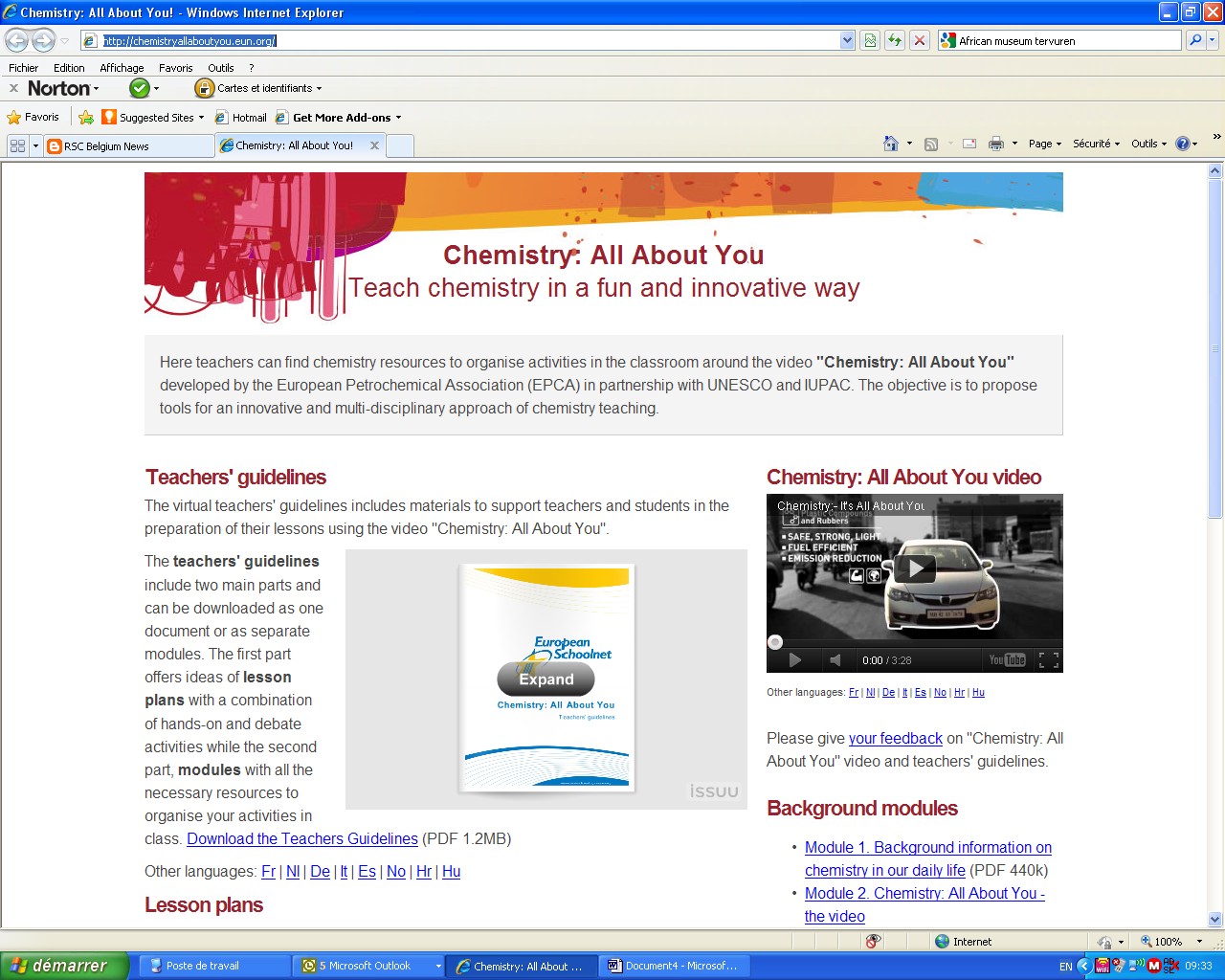
More news on new chemistry resources for teachers has come our way from European Schoolnet. The "Chemistry: all about you" project was developed by European Schoolnet on behalf of the European Petrochemical Association (EPCA) and is aimed at secondary schools teachers.

"Chemistry: all about you" is a project to teach chemistry in a fun and innovative way. It includes an amazing video about chemistry in our life and a teachers' guidelines to plan and support lessons using the video developed by the EPCA. The Teachers' guidelines and the video are available in French, Dutch, German, Italian, Spanish, Norwegian, Croatian and Hungarian in addition to English.


The “Chemistry: all about you” team are keen to receive any feedback on the project that you may have on the content and in particular the teachers' guidelines.

Bryson Prize
The RSC Bill Bryson Prize is designed to encourage and recognise clear science ommunication in schools and colleges. The prize is supported by well-known writer and commentator Bill Bryson (right) who is also involved with the judging process.

For 2012 the Bill Bryson Prize offers the chance to welcome the Olympics to the UK. To support this major event the 2012 competition theme will be "Science and Sport”, to celebrate the major role that science plays in supporting sport around the world.

The Prize is open to students aged 5-18 and entries can be submitted in all formats, from posters to power points to puzzles! The competition will be judged in three categories, primary school, secondary school and International (non-UK) school, with both individual and group entries accepted. The best entries from each category will receive a cash prize of £500 for their institution, and £100 for the winning students – so well worth it!

The closing date for entries is 31 March 2012 and more information including downloadable application forms can be found on the RSC website .

Tuesday, 7 February 2012

LearnChemistry with RSC

The Royal Society of Chemistry (RSC) has just launched a comprehensive online site dedicated to chemistry education. And it is open to all.

The RSC's LearnChemistry website brings together hundreds of resources, a place to share ideas and support for both teachers and students.


The RSC has developed a huge range of educational resources and the LearnChemistry initiative brings them together in one place to make them easily accessible and searchable.

The site also takes a throughly modern approach to teaching using videos, simulations and interactive games to capture students attention and bring the fascination of chemistry into the classroom or home setting.

Talk chemistry
The site features the 'Talk Chemistry' area which provides teachers with a platform to talk about curriculum issues, share news and opinions.

The site also includes Gridlocks - a interactive chemistry game based on the Sudoku concept and a set of videos 'Faces of Chemistry' developed with industrial partners such as Johnson Matthey, Procter & Gamble and Syngenta. In addition the RSC has relaunched and augmented its Visual Elements Periodic Table (see below) to coincide with the LearnChemistry launch.


Content will be continuously added to the site. For example in March the RSC will launch its 2012 Olympic-themed chemistry and sport site. This will examine the role chemistry plays in every sport from archery to aerobics.

The RSC sees LearnChemistry as a community-led site so it is encouraging feedback and input from teachers and students. So why not take a look at LearnChemistry and help us create a new generation of people excited by chemistry.

Science in School
Another web-based resource that will be of interest is 'Science in School' - the European journal for science teachers. It covers not only biology, physics and chemistry, but also earth sciences, engineering and medicine, highlighting the best in teaching and cutting-edge research, and focusing on interdisciplinary work. The contents include teaching materials, recent discoveries in science, education projects, interviews with young scientists and inspiring teachers, and much more.


'Science in School' is freely available. Online articles are published in many European languages and an English-language print version is distributed across Europe. Originally supported by the European Commission, the journal is published and funded by EIROforum, a partnership between eight of Europe’s largest intergovernmental research organisations including including CERN, the European Space Agency (ESA) and the European Molecular Biology Laboratory (EMBL).

European school teachers are invited to help by:
• Submitting articles for publication
• Joining the referee panel and helping to decide which articles to publish
• Reviewing books and other resources for teachers
• Translating articles from English into their native languages.

To subscribe, learn more about the journal or read all the articles visit the Science in School website.

Sunday, 22 January 2012

RSC Belgium AGM 2012

The Belgium section's Annual General Meeting (AGM) and Annual Dinner took place on Friday January 13th at the Restaurant Le Crabe Fantome in Watermael-Boisfort.

The AGM business was transacted swiftly with reports received from 2011 section secretary Ian Carson and Treasurer Rita Woodward.

During International Year of Chemistry 2011 RSC Belgium had been extremely active: organising 12 events directly and participating in the organisation of a further five. The two Cafe Chimiques on Climate Change and GMOs and the Landmark Ceremony for Kekule in Ghent represented new highs for the section. Details of all events can be found in articles published on this blog throughout 2011. For RSC Belgium IYC2011 had been a great success!

It was noted with sadness that 2011 had also seen the death of Keith Price, who had been instrumental in setting up the section.

Dr Paul Gray had also returned to the UK during 2011 and his significant contributions to the section were also noted. The meeting also extended their congratulations to committee member Laura Yonge who had given birth to her daughter Eloise in October.

Committee Elections
In elections for the section committee Tim Reynolds was appointed secretary, taking over from Ian Carson who becomes an ordinary member of the section committee. All other committee members were in mid-term. One elected committee position remained unfilled. It was decided to seek further co-opted members for the committee.

A dedicated section committee page has been established on this blog listing committee members. In addition a forthcoming events page has been set up.

The meeting reappointed Ralph Palim as auditor. Ralph was thanked for his helpful comments and efficient auditing of our finances once again.

Long service rewarded
The meeting closed at 20h10 and members rejoined partners, colleagues and friends for the section's Annual Dinner.


During the meal Tim Reynolds was presented with a RSC Long Service Award by section chairman Bob Crichton (see above). Long Service Awards are presented to members who have served a total of 10 years on a local section committee and held an officer (chair, treasurer or secretary) position during that time. Tim is returning to the role of secretary for 2012 having held that position for six years during a previous 'stint'.

If members would like a copy of the Secretary's report, the treasurer's report or the financial statements presented at the AGM, please contact section secretary Tim Reynolds.

Monday, 12 December 2011

Belgium TOTB Result

RSC Belgium held its Belgian heat for the annual RSC Top of the Bench (TOTB) competition on Saturday 10 December at the British School of Brussels (BSB). It was a close competition between teams from BSB, St Johns International School and the European School II at Woluwe with a team from Woluwe edging the final result.

This was the first time RSC Belgium's TOTB eliminator was an actual 'head-to-head' competition. The five teams of budding chemists (two from Woluwe, two from BSB and one from St. Johns) had to complete a short written test on their individual chemical knowledge and data interpretation skils and then show teamwork and problem-solving abilities in a practical chemical exercise.


This format more closely reflects the format of the competition that the winners will face at the final to be held at Imperial College London on 31 March 2012. Rita Woodward devised the competition and set the questions.

Close competition
All five teams consisted of four students aged 14 - 16 and were accompanied by teachers. The practical aspect of the competition involved the reaction of sodium thiosulfate and hydrochloric acid. The teams had to determine the correct amount and molarity of solutions so that the reaction completed in exactly 2 minutes and 28 seconds. The reaction was said to be completed when a black cross placed under the reaction flask was no longer visible.

When teams had worked out their own solution, their eforts were timed by judges Prof. Bob Crichton and Dr. Ian Carson. Each team had up to two official 'timed' attempts.

The overall winners were determined by their placing in both written and practical parts of the 'eliminator'.


Although the result was tight the winning team and runners-up both came from Woluwe European School. The winning teams are pictured above, together with proud Woluwe chemistry teacher Julie Deegan. The school will now represent Belgium in the (inter)national final in London and receive the section's Keith Price Cup for 2012. All the students who took part in the competition will also receive certificates.

Everyone who took part in the competition had an enjoyable time with both students and teachers very enthusiastic about the new format. RSC Belgium looks forward to an even bigger and better Belgian TOTB eliminator next year.

Our thanks to all the teachers and students who took part in a fun afternoon of chemistry!

Friday, 9 December 2011

IYC Experiment at G4G Two

On Saturday, 26 November 2011, RSC Belgium was part of a very successful second annual GreenlightforGirls event at the International School of Brussels (ISB) . The RSC Belgium team held four lab workshops in three languages featuring two parts of the International Year of Chemistry (IYC 2011) Global Water experiment.

Over 250 schoolgirls from Brussels descended on the ISB for the second annual Greenlight@Brussels Day: an event that promotes science, technology engineering and mathematics ("STEM") to 11-15 year old girls. The RSC Belgium workshop was one of over over 100 hands-on workshops run by role-model scientists, engineers and technology experts, and a Fun Lab full of the latest high-tech gadgetry and science experiments, attendees were exposed to a wide array of exciting activities to inspire them to pursue technical studies and careers. The event was and official part of EU Robotics Week and the International Year of Chemistry 2011.


The RSC Belgium's four hour-long workshops involved the girls getting to grips with the IYC 2011 experiments on the 'pH of water' and how bugs and bacteria are eliminated from our drinking water. The results were added to the IYC 2011 global database of results.

Excellent impact
A follow-up survey to the event showed that it had a very positive impact with 94% of girls who attended saying that the event had encouraged them to pursue science subjects - including some who are not currently enrolled in science studies.

The RSC Belgum workshop global experiment was highlighted as a "favorite part of the day" by participants in their feedback.

The RSC Belgium team was led by Rita Woodward with fellow executive members Ian Carson, Elaine Francke and Tim Reynolds. Our special thanks to students Armourie Prentice and Katrien Laurier who completed the team.

IYC Event: Just the Beginning?

A strong contingent of RSC Belgium members and friends were at the inspiring closing conference for the IUPAC/UNESCO International Year of Chemistry 2011 at the new Square Brussels Meeting Centre on 1 December. Leading figures from the international chemistry community gave their views on the importance of chemistry to solving major global issues, but perhaps the most inspiring visions came from a group of younger people.

The ceremony was opened by HRH Prince Philippe of Belgium and insprational messages were given by Christian Jourquin, CEO of Solvay, European Commissioner for Research Maire Geoghegan-Quinn and IUPAC President Prof. Nicole Moreau.

There then followed a presentation from 13 young leaders drawn from academia and industry around the world. They described their vision of the world in 2050 and how the chemical sciences will make it a better place by addressing the challenges that confront society today.

The vision was presented via three imagined scenarios that were very well thought out and delivered in a thought provoking manner.

A response to these visions was provided by Ada Yonath, 2009 Nobel laureate for chemistry and Jean-Luc Bredas, 1997 Francqui prize winner. Representatives from UNESCO, the OECD, and the Polish Minister Deputy Minister of Economy Hanna Trojanowska also took part in the event along with chief executives representing global chemicals and pharmaceuticals companies.

Outside the main auditorium a small exhibition area featured the life of Maria Sklodowska-Curie, the IYC Global Water Experiment, the Global Stamp Competition, Climate Change, 'Life without Chemistry' and the video 'Chemistry: All about you'.

A great success
The closing ceremony of the International Year of Chemistry was a great success. It was wonderful to see such interest in the creativity and the potential of chemistry to address the challenges facing our societies. High level speakers and young leaders explored and debated how chemistry is vital for solving our most critical global problems including food, water, health, energy, habitat, and more.

However IYC 2011 doesn’t want to stop and the chemistry community is looking to build on the ideas and momentum generated during 2011. More information on the 2050 vision can be found here and a Facebook page has been set up to continue the interaction.