Wednesday, 23 May 2012

TOTB 2012 - The Inside Story

Thanks to Giulia Greed from the European School Brussels II in Woluwe for writing up her Top of the Bench (TOTB) experience for us.

The Scientists (Giulia, Caitriona, Nora, and Thomas - see above) met up with Mrs Deegan at around midday, at Gare du Midi, where we would take the Eurostar to London. Once we had arrived in London, Mrs D bought us underground tickets, and we left for our hotel, which was directly opposite Hyde Park.

We settled in, had a short rest, then we set off again - to Leicester square, to buy tickets for the theatre. We looked at the available shows, and we decided on one of them. Mrs D returned from the ticket booth, clutching the Wicked tickets. The Scientists were all getting hungry, so we went for a meal near Covent Garden, then for an ice cream. Next, we went to the theatre to see Wicked, which was really good. Afterwards, we took the Underground back to the hotel, and then went to sleep.

The next morning, we had breakfast, got ready, then we then left the hotel and set off walking through Hyde Park, to Imperial College (where the competition was being held). While we were walking, Mrs D tested the Scientists and talked to us on chemistry.

Brussels crew
Once we were at Imperial, we were talked through the safety announcements, and soon afterwards we were ushered into a lecture hall, where we would be having the written exam. It only lasted half an hour, then we all had a snack.

Next, was the practical team exam, so we went into the labs. The judges explained: the envelope on the table contained the first challenge. The papers on the side made up the second challenge. Everything we needed was in our workspace. We were given lab coats and gloves. We were known to the judges as “the Brussels crew”.

After the first challenge, we had a one minute break. Then the judges described the second challenge. Both challenges went well. After that we ate lunch, followed by a short break, and then the scientists attended a short lecture on the chemistry in mobile phones.

Next: the award ceremony. Our team came 14th out of 30 - a result we were very pleased with!

Saturday, 12 May 2012

Woluwe at TOTB Final

RSC Belgium was represented at the RSC's Top of the Bench (TOTB) final on 31 March by European School Brussels II at Woluwe (see team photo below). The winners of our own 'national' competition and holders of the Keith Price Cup had a great time at Imperial College London and secured an excellent 'mid-table' result.

"The team came 15th out of around 30 competing schools," reported Julie Deegan, the team's teacher and head of chemistry at Woluwe. "The higher placed teams were all prestigious UK grammar or private schools."


In the highly competitive final each student had to sit an individual written test designed by the RSC and together each team carried out two practical activities: one set by RSC and the other by Imperial College staff.

"The students thought the written test was very traditional and GCSE-like," says Julie. "Questions about the Haber and Contact process, and others about recalling the chemical symbols for less well-known elements were not so popular with our students!"

Practical posers
This year's RSC Belgium eliminator had, for the first time, included a practical element, so the problem-solving laboratory element of the final was not a surprise to the Woluwe team. "The practical task was in two parts," continues Julie. "The first to identify three unknown liquids or solutions using no additional reagents. The second part was a titration, for which the older students had to take a leading role."

The TOTB Final practical session in full swing (image copyright © michele panzeri 2012).

Chemistry Challenge
The next major schools' activity for RSC Belgium is about to commence: the Chemistry Challenge. The papers are being printed for distribution to participating schools. This individual chemistry puzzler is open to 16-17 year old students and we hope to involve well over 100 students in this year's competition.

Wednesday, 28 March 2012

Students Open-mouthed at Chemistry Spectacular

Students from four schools in and around Brussels were left open-mouthed as Prof István Markó and his assistant Fabio Lucaccioni performed their chemistry demonstration lecture “Chemistry and Energy – a Tasty Marriage” at the Université Catholique de Louvain (UCL) site in Woluwe, Brussels on Tuesday March 20th. Two lectures were organised on the day by the RSC Belgium Section in cooperation with Scienceinfuse based at the UCL main campus at Louvain-la-Neuve.

The students, from St. Johns International School, Waterloo, the Verseau International School at Bierges, the Institut Maris Stella at Laeken and the European School Brussels II at Woluwe watched enthralled as Prof. Markó worked through over an hour of about 20 reactions involving flames, colour changes and explosions.


Following Prof. Markó’s advice the students kept their mouths open to equalise the pressure in their ears during the more substantial bangs. A volcano spluttered, photo flash bulbs were simulated, the heat from a ball of flame caused by burning hydrogen in a balloon was felt by the students in the front rows (see above), and a black serpent rose out of a beaker containing only sugar and battery acid. The students oohed and aah’d as blue luminescence spread downwards in a glass tube demonstrating energy generated in a cold reaction.

Enthusiastic response
Prof. Markó engaged his audience with commentary on the chemistry behind the reactions, and his steady repartee – untrammelled by current notions of political correctness – aimed to challenge their ideas and make them think ‘outside the box’. By the end of the lecture though, he had smoke coming out of his nostrils - from eating a Belgian waffle dipped in liquid nitrogen!

After the event, one teacher commented: “Our students were full of enthusiasm and excitement when they got back to school and enjoyed every aspect of the lecture”.

The demo lecture was repeated to a French-speaking schools audience at UCL at Louvain-la-Neuve on Thursday March 22nd in the afternoon and to a public audience on that evening. On both occasions the 500 capacity auditorium was packed. The total audience for all four shows was in excess of 1200.

TOTB cup presented
At the start of the afternoon lecture at Woluwe the winning team in this year’s RSC Belgium local ‘national’ eliminator of the RSC Top of the Bench (TOTB) Competition was presented with the Keith Price Cup. The winning team from European School Brussels II at Woluwe are pictured below with their teacher Julie Deegan and RSC Belgium Section Chairman Prof. Bob Crichton.


The Woluwe team will represent RSC Belgium at the RSC UK final of TOTB at Imperial College London that takes place on Saturday 31 March. We wish the team good luck for the competition and will report on how they get on in London.

The RSC Belgium TOTB Cup has renamed as the Keith Price Cup last year in honour of our first Chairman and principal "founding father" of the section.

A complete list of the experiments performed during our 2012 demonstration lectures is available on request from RSC Belgium’s Schools Coordinator Rita Woodward.

Friday, 16 March 2012

Working for a World Free of Chemical Weapons

RSC Belgium was honoured to welcome the Director-General of the Organisation for the Prohibition of Chemical Weapons (OPCW) Ambassador Ahmet Üzümcü on the evening of 15 March. The Ambassador addressed a large audience of members and friends of the section at the Royal African Museum in Tervuren.

His Excellency Ahmet Üzümcü (pictured left, above with RSC Belgium chairman Prof. Bob Crichton) was appointed Director-General of OPCW in December 2009. Immediately prior to this appointment he served as the Permanent Representative of the Republic of Turkey to the United Nations Office at Geneva.

Ambassador Üzümcü is a career diplomat with vast experience in multilateral diplomacy. He has represented Turkey at the North Atlantic Treaty Organization (NATO) Council, the Conference on Disarmament, the United Nations and other international organisations in Geneva. He has considerable experience in disarmament-related diplomacy, political-military affairs, disarmament and proliferation issues. He held the post of Ambassador of Turkey to Israel from 1999 to 2002.

Chemistry for peace
Ambassador Üzümcü described the rationale for and operation of OPCW and the Convention on Chemical Weapons. Tremendous progress has been made in the destruction of the vast majority of chemical weapon stockpiles around the world. However vigilence is still required to finally eliminate this threat and ensure such weapons do not reappear in the hands of terrorists or new nation states.

"A total ban on chemical weapons is no small achievement for the international community," concluded Ambassador Üzümcü. "We will continue to endeavour to strengthen this norm in order to keep our future generations safe from this scourge which has in the past brought death and untold suffering to those that became victims."

"My message to you is to join this endeavour; to spread the word. To use your considerable expertise, influence and good will to ensure that the norms and values that we share are more widely known and supported. To guarantee through your work with students and apprentices that the chemist will always work for the betterment of the community and never use his knowledge and skills to bring harm to fellow human beings."

OPCW is working with the International Union of Pure and Applied Chemistry to promote the services of chemistry to society, international peace and security.

The full text of the Ambassador's speech can be found here.

Following the Ambassador's talk an extended question and answer ranged over the nature of chemical weapons, current threats to peace and environmental legacy issues.

Wednesday, 7 March 2012

Chemistry Challenge 2012 launched

Following a small pilot run in 2010 and an extremely successful full run in 2011, the RSC Belgium Section is happy to announce the launch of its Schools Chemistry Challenge 2012.

The Chemistry Challenge competition is open to students from any school in Belgium, and we would like to make this year the biggest and best Chemistry Challenge yet!

Details of the 2012 competition format are given below. The questions will be set in English, but may be answered in English, French, Dutch or German.

The competition is open to school students in their penultimate year of High School (usually aged 16 – 17), and consists of a 2 hour written test held in school and designed to demonstrate the participants’ knowledge of chemistry and their ability to think logically. Attractive cash prizes are offered, as well as certificates acknowledging participation.

From previous experience we have found that students feel that participation is a valuable ‘plus point’ when completing University application forms, clearly demonstrating an ‘extra curricula’ interest in a science subject.

A real tester
This paper-based test of knowledge and initiative was devised by RSC member Rita Woodward and is split into three sections:
  • A/ a chemistry multiple choice paper
  • B/ structured questions on chemistry, and
  • C/ a 'Thinking Matters' paper that is not chemistry based

In 2011, almost 80 students participated and RSC Belgium awarded cash prizes to top performers in each section with the winners drawn from the British School of Brussels (BSB), International School of Brussels (ISB), St. Johns International School and the European Schools at Ixelles and Uccle. Some of the winners are pictured recieving their awards and certificates from section chair Prof. Bob Crichton above.

Keith Price Prize
The best overall entry in the two chemistry sections was from Krithika Swaminathan (pictured left) a student at St. Johns school. Krithika was the first recipient of the Keith Price Prize established in memory of one of RSC Belgium's founding members who died earlier this year.

For more information on the 2012 RSC Belgium Chemistry Challenge, please contact our Challenge coordinator Rita Woodward. Further details of the Challenge Rules are outlined below.

Chemistry Challenge 2012 - The rules
The Competition is open to students:
  • who are currently studying Chemistry in their penultimate year in High School eg AS, IB or ES Bacc
  • who enjoy using both chemistry and logic to solve exercises and puzzles, and
  • who have a good grasp of the principles and a thorough knowledge of the chemistry they have studied
The challenge is:
  • One written 2 hour paper taken under examination conditions in school in May/June 2012
Other information:
  • Calculators are allowed - but not graphical or programmable
  • Maximum total mark will be 120
  • All questions for sections A and B (worth 90 marks) on chemistry will be compulsory
  • For Section C (worth 30 marks) on logic there will be a choice of questions. The questions will test the student's ability to handle logic, verbal comprehension and symbolic knowledge and to think creatively
  • For 2012 the Chemistry Challenge Competition questions will be available in English. Teachers are free to translate the questions. Candidates may answer in Dutch, English, French or German
Awards:
  • For each of the Sections A, B and C all candidates will receive a Certificate: Gold or Silver or Bronze
  • In each section, the highest score will receive a prize of €50, second highest €25, and third highest €10
  • In addition, the highest total score from Sections A + B will receive “The Keith Price Prize” of €100
In the event of a tie for the Keith Price Prize, scores from Section C will be used to select the final winner.

We hope for a record entry in 2012 with some excellent students testing their knowledge and pitting their brains against those of their peers.

Monday, 13 February 2012

More resources, more prizes

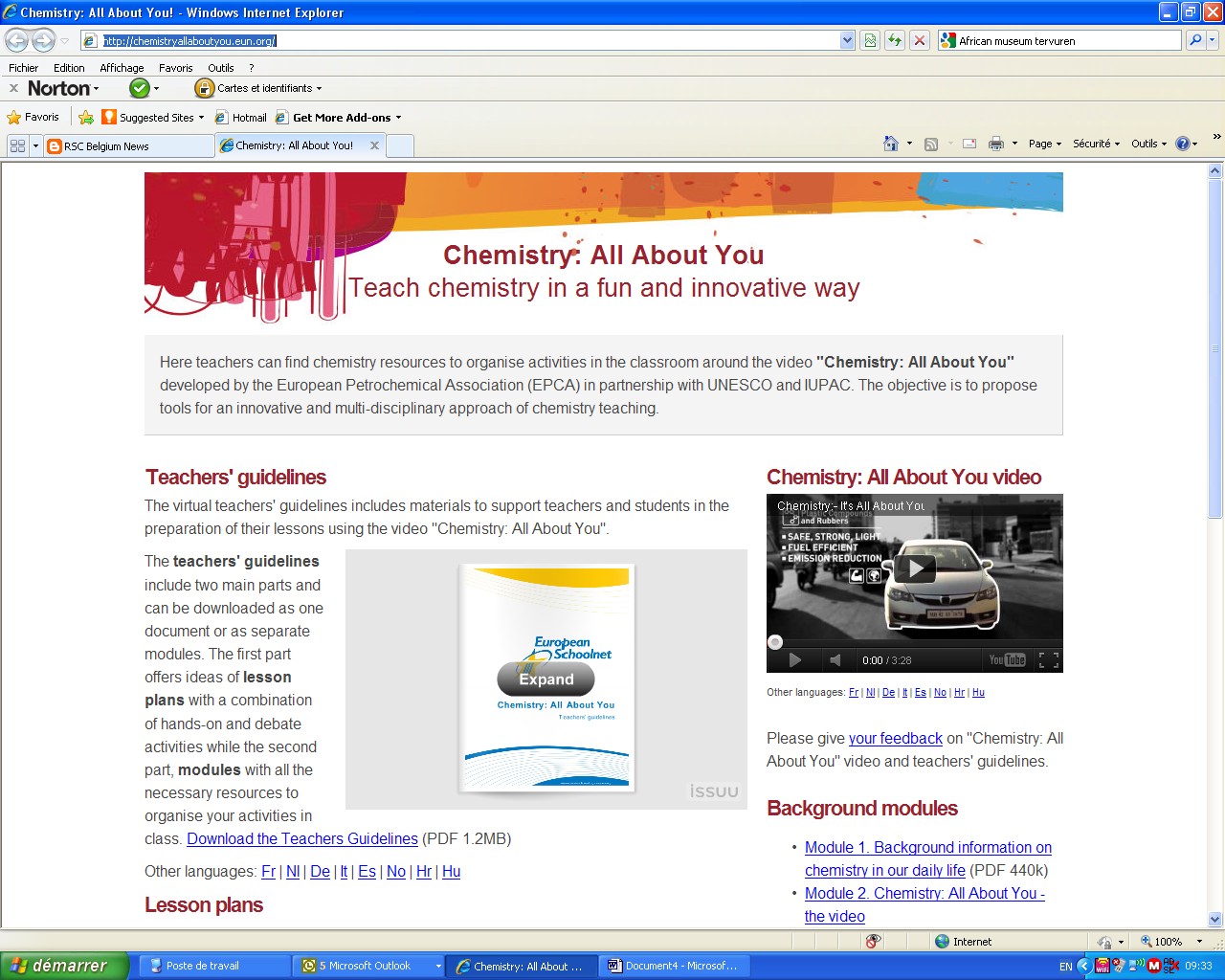
More news on new chemistry resources for teachers has come our way from European Schoolnet. The "Chemistry: all about you" project was developed by European Schoolnet on behalf of the European Petrochemical Association (EPCA) and is aimed at secondary schools teachers.

"Chemistry: all about you" is a project to teach chemistry in a fun and innovative way. It includes an amazing video about chemistry in our life and a teachers' guidelines to plan and support lessons using the video developed by the EPCA. The Teachers' guidelines and the video are available in French, Dutch, German, Italian, Spanish, Norwegian, Croatian and Hungarian in addition to English.


The “Chemistry: all about you” team are keen to receive any feedback on the project that you may have on the content and in particular the teachers' guidelines.

Bryson Prize
The RSC Bill Bryson Prize is designed to encourage and recognise clear science ommunication in schools and colleges. The prize is supported by well-known writer and commentator Bill Bryson (right) who is also involved with the judging process.

For 2012 the Bill Bryson Prize offers the chance to welcome the Olympics to the UK. To support this major event the 2012 competition theme will be "Science and Sport”, to celebrate the major role that science plays in supporting sport around the world.

The Prize is open to students aged 5-18 and entries can be submitted in all formats, from posters to power points to puzzles! The competition will be judged in three categories, primary school, secondary school and International (non-UK) school, with both individual and group entries accepted. The best entries from each category will receive a cash prize of £500 for their institution, and £100 for the winning students – so well worth it!

The closing date for entries is 31 March 2012 and more information including downloadable application forms can be found on the RSC website .

Tuesday, 7 February 2012

LearnChemistry with RSC

The Royal Society of Chemistry (RSC) has just launched a comprehensive online site dedicated to chemistry education. And it is open to all.

The RSC's LearnChemistry website brings together hundreds of resources, a place to share ideas and support for both teachers and students.


The RSC has developed a huge range of educational resources and the LearnChemistry initiative brings them together in one place to make them easily accessible and searchable.

The site also takes a throughly modern approach to teaching using videos, simulations and interactive games to capture students attention and bring the fascination of chemistry into the classroom or home setting.

Talk chemistry
The site features the 'Talk Chemistry' area which provides teachers with a platform to talk about curriculum issues, share news and opinions.

The site also includes Gridlocks - a interactive chemistry game based on the Sudoku concept and a set of videos 'Faces of Chemistry' developed with industrial partners such as Johnson Matthey, Procter & Gamble and Syngenta. In addition the RSC has relaunched and augmented its Visual Elements Periodic Table (see below) to coincide with the LearnChemistry launch.


Content will be continuously added to the site. For example in March the RSC will launch its 2012 Olympic-themed chemistry and sport site. This will examine the role chemistry plays in every sport from archery to aerobics.

The RSC sees LearnChemistry as a community-led site so it is encouraging feedback and input from teachers and students. So why not take a look at LearnChemistry and help us create a new generation of people excited by chemistry.

Science in School
Another web-based resource that will be of interest is 'Science in School' - the European journal for science teachers. It covers not only biology, physics and chemistry, but also earth sciences, engineering and medicine, highlighting the best in teaching and cutting-edge research, and focusing on interdisciplinary work. The contents include teaching materials, recent discoveries in science, education projects, interviews with young scientists and inspiring teachers, and much more.


'Science in School' is freely available. Online articles are published in many European languages and an English-language print version is distributed across Europe. Originally supported by the European Commission, the journal is published and funded by EIROforum, a partnership between eight of Europe’s largest intergovernmental research organisations including including CERN, the European Space Agency (ESA) and the European Molecular Biology Laboratory (EMBL).

European school teachers are invited to help by:
• Submitting articles for publication
• Joining the referee panel and helping to decide which articles to publish
• Reviewing books and other resources for teachers
• Translating articles from English into their native languages.

To subscribe, learn more about the journal or read all the articles visit the Science in School website.