Wednesday, 13 July 2016
Our Second Norman Lloyd Scholar completes Year
What degree are you undertaking and why did you choose the course here?
I am studying Chemistry simply because it gives a logical explanation to very complicated questions. I'm an individual who always likes searching for answers thus Chemistry seemed the obvious choice for me.
What’s the best thing about studying at Cardiff?
Clearly, the university itself is respected across the entire country, which alone is enough reasoning to be satisfied but I also love the city. It's such a welcoming place which makes studying here all the more better.
Do you have a particular career in mind after you graduate?
As I've only finished my first year, I don't want to tie myself down to a particular career path at this moment in time. There's a lot of different aspects of Chemistry I enjoy, from the physical aspect to biological applications, so any one of these routes would be an exciting career for me.
What’s was your favourite module during your first year of study?
As mentioned above, various aspects of Chemistry capture my imagination thus picking a favourite is very difficult. Having said that, the history behind Inorganic Chemistry and how different theories have been used over the years really makes me appreciate the importance of the degree.
Do you have any hobbies outside of studying?
As university life can get stressful at times, I do love taking my mind off things by doing any form of sports. A great passion of mine is football but since moving to Cardiff, I have been spending more time in the gym.
What difference has this scholarship made to you?
Without a doubt, the biggest impact that the scholarship has made is given me confident in my own abilities. I must admit, moving into a lecture room with nearly 200 students can be daunting at times thus I am thankful for the boost in confidence it gave me.
If you could say something to the donor who gave you this gift, what would it be?
From the bottom of my heart, I am truly grateful for the scholarship. It has enhanced my university experience and that is something I shall cherish.
We wish Rhodri all the best for the future and every success in his future studies at Cardiff.
The scholarship
The Norman Lloyd scholarship was set up by RSC Belgium in collaboration with Norman’s family and Cardiff University in memory of our old friend and supporter Norman Lloyd. Norman was himself a student at an institution that is now part of the university. The funds raised provide an annual scholarship of £1,000 for an undergraduate student, usually in their first year of study. The scholarship is given to new students to the Cardiff School of Chemistry who are of high academic standing and a resident of Wales. The next Norman C Lloyd scholar will be selected in October.
If you would like to donate to the Norman Lloyd scholarship fund follow this link and specify that you wish to donate to the Norman Lloyd Scholarship fund in the comments box.
Thursday, 13 August 2015
First Norman Lloyd Scholar's First Class First Year
Dale Lyons (right) received the scholarship for 2014/2015 to help her in the first year of a four year Chemistry with a year in industry (MChem) degree programme. She is looking forward to her year in industry which she hopes will help her to decide which career path to take after her studies. Dale's favourite module in year one has been Solid State Chemistry.
Dales says that receiving the scholarship "has made a massive difference. I have been able to buy textbooks rather than wait for them to be available in the library which has helped a lot with revision. Having the scholarship has motivated me throughout the year to do well and eased some of the pressure in terms of worrying about money. Thank you so much."
Clearly the support of the scholarship has been very useful and Dale has received a first-class honours for her first year of study at Cardiff. Well done Dale!
In the Autumn a new first year student will been selected to receive the 2015/2016 scholarship.
Tuesday, 28 October 2014
First Norman C Lloyd Scholarship announced
Saturday, 9 June 2012
RSC ready for the Olympics
In time for the London 2012 Olympic Games the Royal Society of Chemistry has launched a new Chemistry in the Olympics website and a global experiment to engage students with the chemistry behind the Olympics. The website features educational resources for teachers and students to explore the chemistry behind sport.
Alistair Brownlee, twice world champion triathlete and a former chemistry student, introduces the global experiment and talks about the role chemistry played in his own education and how chemistry is vital to his sport.
The RSC is promoting the global experiment to school students around the world and participants from the UK, USA and New Zealand have already been involved - so why not take a look and have a go yourself?
The experiment aims to test the effects of sports drinks on athletic performance and encourages participation from students of all ages. The experiment and activities can be completed at school in groups or individually at home. Particpants are asked to:
- Run 100 metres after consuming either a sports drink or water
- Test the effects of sports drinks on physical performance
- Anaylse the data and discuss the role of chemistry in sports drinks
- Upload their results and location to an interactive map to compare with students all over the world
The RSC have formulated a generic sports drink recipe including sugar-free squash, water, salt and sugar. Watch the new Global Experiment video where a class of primary students show ho wthey did the experiment.
Children in school and at home are encouraged to take part and upload their results before the start of this year's London Olympics on 27th July.
Monday, 13 February 2012
More resources, more prizes
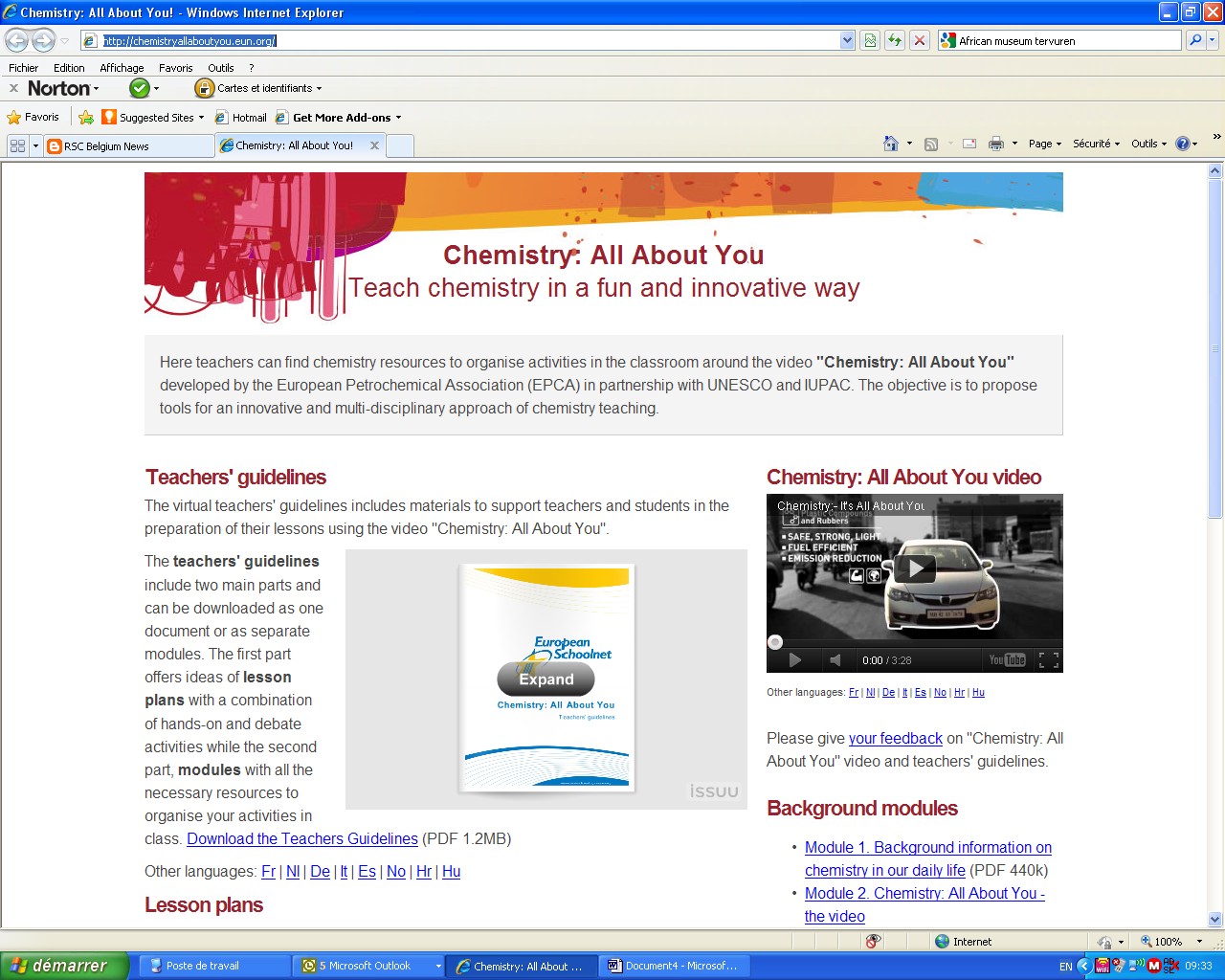
"Chemistry: all about you" is a project to teach chemistry in a fun and innovative way. It includes an amazing video about chemistry in our life and a teachers' guidelines to plan and support lessons using the video developed by the EPCA. The Teachers' guidelines and the video are available in French, Dutch, German, Italian, Spanish, Norwegian, Croatian and Hungarian in addition to English.

The “Chemistry: all about you” team are keen to receive any feedback on the project that you may have on the content and in particular the teachers' guidelines.
Bryson Prize
The RSC Bill Bryson Prize is designed to encourage and recognise clear science ommunication in schools and colleges. The prize is supported by well-known writer and commentator Bill Bryson (right) who is also involved with the judging process.For 2012 the Bill Bryson Prize offers the chance to welcome the Olympics to the UK. To support this major event the 2012 competition theme will be "Science and Sport”, to celebrate the major role that science plays in supporting sport around the world.
The Prize is open to students aged 5-18 and entries can be submitted in all formats, from posters to power points to puzzles! The competition will be judged in three categories, primary school, secondary school and International (non-UK) school, with both individual and group entries accepted. The best entries from each category will receive a cash prize of £500 for their institution, and £100 for the winning students – so well worth it!
The closing date for entries is 31 March 2012 and more information including downloadable application forms can be found on the RSC website .
Tuesday, 7 February 2012
LearnChemistry with RSC
The RSC's LearnChemistry website brings together hundreds of resources, a place to share ideas and support for both teachers and students.

The RSC has developed a huge range of educational resources and the LearnChemistry initiative brings them together in one place to make them easily accessible and searchable.
The site also takes a throughly modern approach to teaching using videos, simulations and interactive games to capture students attention and bring the fascination of chemistry into the classroom or home setting.
Talk chemistry
The site features the 'Talk Chemistry' area which provides teachers with a platform to talk about curriculum issues, share news and opinions.
The site also includes Gridlocks - a interactive chemistry game based on the Sudoku concept and a set of videos 'Faces of Chemistry' developed with industrial partners such as Johnson Matthey, Procter & Gamble and Syngenta. In addition the RSC has relaunched and augmented its Visual Elements Periodic Table (see below) to coincide with the LearnChemistry launch.

Content will be continuously added to the site. For example in March the RSC will launch its 2012 Olympic-themed chemistry and sport site. This will examine the role chemistry plays in every sport from archery to aerobics.
The RSC sees LearnChemistry as a community-led site so it is encouraging feedback and input from teachers and students. So why not take a look at LearnChemistry and help us create a new generation of people excited by chemistry.
Science in School
Another web-based resource that will be of interest is 'Science in School' - the European journal for science teachers. It covers not only biology, physics and chemistry, but also earth sciences, engineering and medicine, highlighting the best in teaching and cutting-edge research, and focusing on interdisciplinary work. The contents include teaching materials, recent discoveries in science, education projects, interviews with young scientists and inspiring teachers, and much more.

'Science in School' is freely available. Online articles are published in many European languages and an English-language print version is distributed across Europe. Originally supported by the European Commission, the journal is published and funded by EIROforum, a partnership between eight of Europe’s largest intergovernmental research organisations including including CERN, the European Space Agency (ESA) and the European Molecular Biology Laboratory (EMBL).
European school teachers are invited to help by:
• Submitting articles for publication
• Joining the referee panel and helping to decide which articles to publish
• Reviewing books and other resources for teachers
• Translating articles from English into their native languages.
To subscribe, learn more about the journal or read all the articles visit the Science in School website.