Friday, 2 June 2023

New Horizons in synthesis: click chemistry and beyond

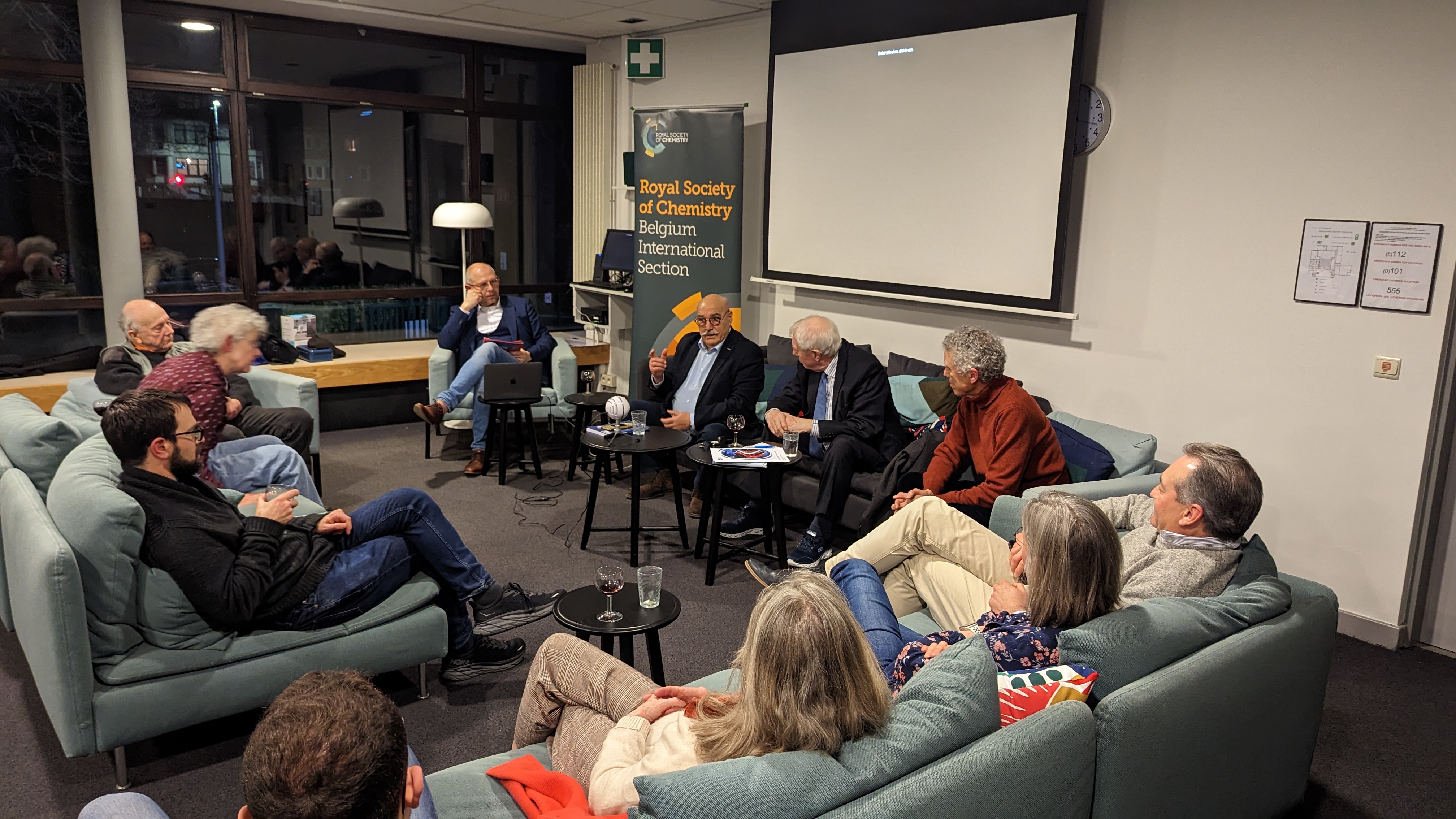
On the evening of Thursday 20 April from 19h30 RSC Belgium welcomed Professor Ari Koskinen, Emeritus Professor of Organic Chemistry at Aalto University, Finland to talk to us about ‘New Horizons in synthesis: click chemistry and beyond’. The event was held at the British School of Brussels in Tervuren and was followed by an opportunity for RSC members and friends to network and ask informal questions of the speaker over drinks and snacks.

A central feature of chemistry is to produce novel connections between atoms, in other words chemical synthesis. The state of the art of organic chemical synthesis is defined by the complexity of the target structures one can produce in an efficient manner. Especially during the past two decades, different economies of synthesis have taken a central role in the development of synthetic chemical strategies. Thus atom economy, step economy, redox economy are valid targets for synthesis research.

‘Click chemistry’ and biorthogonal chemistry are timely subjects and Ari took us through a brief history of organic synthesis and introduced us to the latest trends in this important part of chemistry. 

The 2022 Nobel Prize in Chemistry was awarded to Carolyn Bertozzi, Morten Meldal, and Barry Sharpless for the development of click chemistry and bioorthogonal chemistry.

As usual, the session was recorded and you can access it direct via the RSC YouTube channel here or via the embedded video below.

Our speaker

Professor Ari Koskinen (pictured below) received his M.Sc. (Chem. Eng.) in 1979, his Licentiate in Technology in 1982 and his Doctor of Technology in 1983 from the Helsinki University of Technology.

After postdoctoral studies at the University of California, Berkeley he accepted an appointment as a Project Leader in New Drug Development at Orion Corporation – Fermion, Finland where his research group was among the first in Scandinavia to adopt computer aided drug design as well as computerized database handling protocols in new lead identification. Returning to academia, he joined the University of Surrey as a lecturer in 1989 and was then appointed as Professor of Chemistry (especially Synthetic Organic Chemistry) at the University of Oulu, Finland in 1992, and transferred to the Helsinki University of Technology in 1999 (Aalto University since 2010) as Professor of Organic Chemistry.

Prof. Koskinen is a member of the Finnish Academy of Sciences and Letters since 2003. He is the author or co-author of some 190 publications, 15 patents and three books. He retired from active academic work in October 2021, but as emeritus professor, he keeps his finger on the pulse of organic chemistry through activities in IUPAC (Division of Organic and Biomolecular Chemistry) and EuChemS (secretary, Division of Organic Chemistry).


Monday, 17 April 2023

Catalyzing the road to sustainable e-fuels

On the evening of Thursday 23 March 2023 RSC Belgium welcomed Professor Damien Debecker from UCLouvain to the British School of Brussels in Tervuren to talk about ’CO2 and H2: catalyzing the road to sustainable e-fuels?’ Professor Damien Debecker is a professor within the Faculty of bio-science engineering at UCLouvain and is currently holder of a Francqui Research Professor chair.

As we all know the mitigation of net CO2 emissions is currently an absolute priority challenge for society for which various strategies must be implemented in parallel. One useful technology, which falls under the umbrella of the Carbon Capture and Utilization (CCU) concept relies on the catalytic hydrogenation of CO2 to methane, methanol, or higher hydrocarbons.

When methane is targeted, this process is called methanation or the Sabatier reaction. Prof Debecker took us through recent developments in the design of highly active methanation catalysts and then placed these developments in a more general context, questioning the sourcing of both CO2 and H2 and highlighting the fundamental role of renewable electricity in so-called sustainable processes.

The talk covered a number of issues relating to sustainable chemical processes, future energy production and the sense (or non sense) of certain proposed solutions. A lively Q&A session follwoed teh talk and continued during moe informal networking afterwards.

The session was recorded and you can access it direct via the RSC YouTube channel here or via the embedded video below.


Friday, 14 April 2023

BSB at Top of the Bench Final

Our 2022 Belgium Top of the Bench champs – Team Sodium from the British School of Brussels (BSB) – competed in the Royal Society of Chemistry’s 2023 Top of the Bench national final on 25 March at the University of East London (UEL). The BSB team were the only non-UK team in the 31 competitors. The competition tests the chemistry knowledge of 14–16 year-old students through written and practical exercises.

Students had to complete a 40-minute chemistry knowledge exam in pairs, followed by a 90 minute hour practical team exercise in UEL’s labs. The theme of the final was sustainability with a practical challenge on sustainable energy that included a calorimetry task, density determination and finally an analysis of some possible “future fuels”. 

The teams also had a talk from Tony Raynham, the course leader for the University of East London Chemistry department, about the course (a new course only just set-up), his life history and journey about how he got to where he is now and then a talk on apprenticeships from an RSC speaker. 

Tony Raynham said that UEL was delighted to host the talented young chemists in the Bioscience department.

Unfortunately, BSB did not win; Winchester College (winning team pictured above) took top place. The winning team received a trophy and Amazon gift vouchers, and will be sent £500 for their school to spend on science equipment. The first runners-up, four students from Colchester County High School for Girls, received Amazon vouchers. Hannah Addiscott from The Grange School was awarded the Jacqui Clee Award for the most outstanding individual contribution.

BSB chemistry teacher and RSC Belgium committee member Jonathan Norris escorted the BSB party and commented: “The students really enjoyed themselves, despite a long day.” The BSB team made the trip to and from London in a day.

Despite not winning all the students came away with a free t-shirt and a periodic table and the accompanying teachers got a thermochromic mug, a RSC lanyard, and a fetching RSC tote bag.

Next year’s final will be in Edinburgh and RSC Belgium will be planning to send a team as usual.

Friday, 17 February 2023

How to make Urban Transport more Sustainable?

On the evening of Thursday 9 February 2023 the section kicked off its 2023 programme of events with a Café Chimique on 'Sustainable Transport' at the British School of Brussels in Tervuren. 

For our society,  one of the greatest challenges is to plan and invest wisely for sustainable transport. Transport plays a crucial role in economic development by providing access for people to education, markets, employment, recreation, health care and other key services not to mention enabling the movement of goods. Enhancing mobility for all parts of society is one of the most important preconditions for achieving economic, environmental and social goals.

In reality, transportation systems in most urban areas are far from ideal. Motorised modes still dominate and traffic congestion is ubiquitous making a significant impact on local and national GDP, degrading the urban environment and affecting citizens’ health and quality of life.

What are the solutions? What does a sustainable transport system look like? How can it be achieved? How will it be fuelled? What new or existing technologies are needed to make such systems happen? Where can the chemical sciences help? And what else is needed in terms of cultural or behavioural change by citizens?

For the debate RSC Belgium members and friends were joined by two speakers to (hopefully) find some answers to these questions and more. Section chair Prof Bob Crichton introduced the two speakers.

Prof Samuel Furfari is a recognized authority on energy policy based in Brussels. Following a 36 year career with the European Commission's DG Energy, he was appointed as a professor of geopolitics of energy at various universities including at the Université Libre de Bruxelles. He is President of the European Society of Engineers and Industrialists.

After 21 years at the UK Transport Research Laboratory, Paul Kompfner moved onto the European stage in 1992, to help set up Europe's first multi-sector partnership for deployment of intelligent mobility. Now independent following 25 years at ERTICO-ITS Europe, he is working with various projects to promote sustainable mobility of people and goods in cities

Our two speakers provided short introductory talks that was followed by an audience led Q&A discussion. As with our previous Cafe Chimiques the audience will be seated in a relaxed café-style format and a gratis bar and snacks were throughout  the evening. 

The presentations and debate were recorded is now available via our YouTube channel or below. Enjoy!

2023 Section AGM and Annual Dinner

On Friday 20 January 2023 the 2023 Annual General Meeting (AGM) and Annual Dinner of the Royal Society of Chemistry's Belgium International Section 023 was held at Les Amis Dinent Restaurant, Chaussee de Malines/ Mechelsesteenweg 113, 1970 Wezembeek-Oppem.

The meeting commenced at 19h35. Seven section members were present: Bob Crichton, Tim Reynolds, Julie Tuppeny, Fabio Lucaccioni, Rita Woodward, Susan Schamp, and Ricky Payen. Also in attendance were co-opted Committee members: Bo Dahlqvist and Jonathan Norris. Seven section members who were unable to attend the AGM sent their apologies and had asked the Chair to act as their proxy for the meeting if a vote was required. These members were: David Terrell, Dharmjeet Madhav, Deepak Pant, Filip du Prez, Steven De Feyter, Richard Green and Catherine Cazin.

1. Apologies for absence

Stefaniya Velichkova.

2. Approval of Minutes of 2022 AGM

No corrections were suggested, and the meeting moved (Rita Woodward), seconded (Fabio Lucaccioni) and unanimously adopted the minutes.

4. Committee Report on the Section’s 2022 Activities (Tim Reynolds – Secretary)

The Secretary presented the 2022 report.

“2022 saw the section’s activities return to (relatively) normal operation as the impact of COVID reduced and restrictions were lifted. During 2022 RSC Belgium managed to organise seven public lectures (either as webinars or hybrid events), a virtual AGM, a summer social event in Brussels, a fund raising social for our Norman Lloyd Scholarships, and our two annual school outreach events: the Chemistry Challenge and the Top of the Bench ‘Eliminator’, which was an in-person event. Our eighth Norman Lloyd scholarship recipient enjoyed his first year at Cardiff University and we have just got the name of the next recipient.

Our 2022 AGM was once again run as a webinar event on the evening of 14 January and was subsequently made available on our dedicated @RoySocChemBelgium YouTube channel. Two members were elected to the section committee for a two-year term: David Terrell and Dharmjeet Madhav. During the year your section committee met five times on 18 January (virtual), 29 March (hybrid), 19 May (virtual), 13 September (hybrid) and 22 November (hybrid).

Our 2022 programme of talks kicked off on 24 February with a webinar from RSC President Professor Tom Welton OBE on Green and Sustainable Chemistry. This was followed on 31 March with a webinar event on Chemical recycling of plastic wastes with Henk Pool of Cefic – the European Chemical Industries Association.

The outlook for nuclear energy in Europe was the subject of our third webinar on 28 April with Andrei Goicea from FORATOM, while on 19 May our members and friends tuned in for a webinar describing a major breakthrough for the prevention of breast cancer recurrences and metastases with Professor Pierre Sonveaux of the Universite Catholique de Louvain.

Fortunately during the long summer, we were able to restart in-person events with two social events. On Saturday 2 July, we were treated to a fascinating guided walk exploring ‘Foreign Bodies’ in the centre of Brussels led by Dr Paul Snell who  specialises in art and architectural tours. Raising funds for our Norman Lloyd Scholarships was the main aim of a social event on 20 August hosted by Rita and Peter Woodward in their beautiful garden in Duisberg. The sunny event raised Eur 920.

On 29 September we welcomed back both a ‘live’ audience and our good friend Professor Vincent Lemaitre from Universite Catholique de Louvain to discuss the latest thinking in high energy and astrophysics. The event was held the British School of Brussels and we also attempted to livestream the event – unfortunately the webinar feed cut out early on. This event was also the prize-giving ceremony for our 2022 Chemistry Challenge initiative undertaken as a virtual event over the early summer with the students working remotely at their schools. For the 2022 Challenge, we received entries from most of our group of international and European schools with 65 students participating.

On 20 October we reverted to a webinar format launching into deepest space with an entertaining and informative talk on 'Exoplanets or the quest for other worlds beyond our solar system' from Prof Michaël Gillon of the University of Liege. Our final talk of the year was on 24 November when we welcomed another old friend, Professor David Leigh from University of Manchester, to talk about ‘Making the tiniest Machines’ with some extraordinary chemistry and also some marvellous magic! This was a ‘live’ event, but we suffered with poor sound quality on the webinar recording. 

On Saturday 17 December we were able to hold our first in-person Top of the Bench (TOTB) regional heat for a while. The heat was held later in the year than normal and just two schools were able to field two teams each to compete on the day. However, the competition was extremely keen and a very tight contest was eventually won by Team Sodium from the British School of Brussels who will represent Belgium section at the London finals in March. Thanks as ever to Rita and Susan for developing the written and practical tasks for Top of the Bench and the teams for their enthusiasm.

During the year, our eighth recipient of a Norman Lloyd scholarship at Cardiff University, Martim Gouveia Pereira, worked hard despite the issues around studying during Covid. He says that he has used the scholarship to invest in his soft skills which has led him to be shortlisted by Oxford Medical School to read Medicine in 2024. And we have just received news of ninth recipient, Benjamin Condon, who started his MChem degree course in the Autumn term.

As mentioned earlier we now have a YouTube channel where you can find our videoed webinars. Some of our @RoySocChemBelgium ‘content’ has proved to be very popular. Our Top Three videos (as of 17 January 2023) are at #3 Philip Ball with 659 views, second spot goes to Plasma-based CO2 conversion with 3,122 views, while Nick Lane is top of the pops with a remarkable 8,272 views.

We hope to again run a full programme of in-person events during 2023, the majority of which we hope to record and then post on YouTube. We look forward to seeing many more members and friends face-to-face during the year. Details of forthcoming events can always be found on the RSC Belgium blog.

We aim to kick off our 2023 programme with a Café Chimique at BSB on 9 February 2023 on the topic of 'Sustainable Urban Transport'. Further details on this and future events will be announced soon.”

There were no questions on the report, and the meeting moved (Susan Schamp), seconded (Julie Tuppeny) and unanimously approved adoption of it.

5. Financial Report of 2022 (Julie Tuppeny – Treasurer)

The treasurer presented the 2022 financial report and accounts.

“At the beginning of 2022 continued restrictions due to Covid-19 pandemic meant that the first four lectures of the year were online. However, both Tom Welton and Henk Pool had large registrations of 70 and 108 participants, respectively.

Our first in person event was the walking tour of Brussels on 2 July with sixteen participants. Our first live event was the lecture at BSB with Vincent Lemaitre with forty people attending in person and ten online.

Our two annual competitions for schools, the Chemistry Challenge Competition had sixty-five students taking part from seven schools and the Top of the Bench (TOTB) Eliminator Round was in person for the first time in two years with two schools and four teams taking part.

On 1 January 2022, the net assets of RSC Belgium Section were €11,665.28 The Annual Grant for 2022 was received in June 2022 from RSC UK of € 4,000.

Major items of expenditure are listed below:

  • Chemistry Challenge of which €395 was prize money.
  • David Leigh lecture due to hotel costs.

For the Year ending 31 December 2022, the net assets of RSC Belgium Section amount to €11,710.04 in the current account and €2,103.26 in the Savings account giving a total of €13,813.30.

This balance will enable the RSC Belgium Section to offer a broad selection of public lectures from visiting speakers this coming year.

However, bearing in mind that Belgian Law, the status of the RSC Belgium Section holds the three Officers personally liable for debts arising from the activities of the Belgium Section we will ensure that the bank balance always remains in good standing.”

The meeting unanimously adopted the Treasurer’s report.

6. Chair’s Remarks (Bob Crichton)

The Chair thanked all members of the committee for their continuing hard work and support and looked forward to continuing success in this new year.

In particular he looked forward to a complete return to live events during 2023. The committee had recently decided to focus on live, in-person events rather than hybrid. However, the majority of our events would be recorded for viewing or presentation via our YouTube Channel. The only thing that could stand in the way of this was a return of COVID, but that was something that was out of our hands.

The section’s 2023 programme was shaping up and in addition to the Cafe Chimique on Transport in February, the section hoped to be welcoming back Hal Sosabowski for demonstration lectures, inviting a talk from researchers at the John Innes Centre on genetically modified crops and investigating the role of mRNA in new cancer treatment and other medical developments.

7. Election of committee members and section officers

The following nominations had been received for election to the committee.

Chair:              Prof Bob Crichton

Secretary:        Mr Tim Reynolds

Treasurer:        Mr Fabio Lucaccioni

Committee:     Mrs Rita Woodward, Dr Susan Schamp, Ms Julie Tuppeny

All positions are for a two-year term. As the number of nominations equalled the number of vacant positions, all candidates were duly elected.

Two committee members are in mid-term: Dr David Terrell and Dr Dharmjeet Madhav.

At the first committee meeting of 2023 Bo Dahlqvist and Jonathan Norris will also be co-opted onto the committee.

8. Auditing arrangements for 2023

Julie confirmed that accounts must be prepared and submitted to RSC HQ by 27 January  2023. These accounts did not require a formal audit prior to submission. If a review/ audit was required section member Lance Smallshaw had agreed to assist.

9. Any Other Business

As noted previously the first event of the 2023 programme will be on the evening of Thursday 9 February 2023 with a Café Chimique on Sustainable Urban Transport at the British School of Brussels.

The meeting Adjourned at 20h10. The first meeting of the 2023 committee has been provisionally scheduled for Tuesday 14 March 2023 from 19h15.

The meeting was followed by the sections Annual Dinner.


Monday, 23 January 2023

Top of the Bench back in-person for 2022

On Saturday 17 December, RSC Belgium was able to hold our first in-person Top of the Bench (TOTB) regional heat for a few years. The heat was held later in the year than normal, which meant that just two schools were able to take part. But both the British School of Brussels (BSB) and St. Georges International School from Luxembourg were able to field two teams each to compete on the day for a very tight competition.

BSB were on home 'turf' as the event was held in the chemistry laboratories at the school in Tervuren. St. Georges travelled up from Luxembourg on the day arriving in good time for 'kick off' at 13h30.

This year the first part of the competition was an 'Escape Room Challenge' quiz devised by RSC Belgium Committee member Susan Schamp. This was a bit of an icebreaker and definitely a teambuilding effort. Each team had to solve a chain of clues with the first team to ‘escape’ deemed the winner.

After refreshments the second element of the day was the Practical Activity Challenge in which team members needed to make some strategic choices, carry out experiments, process observations and relate their findings to a potential application of recycling a metal. The practical element was, as ever, devised by RSC Committee member Rita Woodward.

Joining Rita and Susan in observing and judging the event were Tim Reynolds and Olivier Schamp (pictured above). RSC teaching staff was represented by Jonathan Norris and St. Georges teachers present throughout the day were Kayleigh van Dongen and Marco Macedo Foz.

A close result

The competition was extremely keen and a very tight contest was eventually won by Team Sodium from the British School of Brussels. In second place was Team Fluorine from St Georges with their Copper team taking 'bronze' position. Team Iodine from BSB was not far behind in fourth.

BSB's Team Sodium won the coveted Keith Price Cup (see above) and will now represent Belgium section at the National finals of TOTB that will be held on Saturday 25 March 2023 at the University of East London. The theme of this event will be Sustainable Energy.

Our thanks as ever to Rita and Susan for developing the written and practical tasks for our Top of the Bench event and all the teams for their enthusiasm and hard work. Congratulation to the winners and everyone who took part.

Eighth Norman Lloyd Scholar report is in!

Martim Gouveia Pereira (pictured below), the eighth recipient of a Dr Norman C. Lloyd Scholarship at Cardiff University has completed the first year of his MCheM degree in Chemistry at the university and he has submitted an end of year report. The Norman Lloyd Scholarship is given to a new student in the Cardiff School of Chemistry who is of high academic standing and resident in Wales. The ninth recipient of the Scholarship at Cardiff has also just been announced.


What degree are you undertaking and why did you choose the course here?

I am studying BSc Chemistry at Cardiff University. I chose this course due to the excellent reputation of the university, the lecture and laboratory facilities and the opportunities that would be afforded to me once I have completed my degree.

What is the best thing about studying at Cardiff and how have you found your experience so far?

The best thing about studying at Cardiff was being able to leave the sixth form bubble. In high school, you are exposed to people living in the same part of town. In college, you are exposed to students from around the city. In university, you have the chance to meet other students from around the country and even abroad! I have had the most fantastic time at university, and I am certain that I am now ready for the next steps after graduation.

Do you have a career in mind after you graduate/what are your plans after you graduate?

After graduation, I will be reading Medicine at the University of Oxford. My goal is to pursue a career in Medicine and Education.

Achievements/what you enjoyed most and what have you found most challenging?

The transition from post-lockdown Year 13 to university proved to be difficult at first. I needed to develop healthy, yet effective study habits lost during lockdown and university has enabled me to achieve this. I have also been able to attend enrichment conferences in London which helped me to network with much more experienced professionals from all around the country.

Do you do anything extracurricular in your spare time/alongside your degree?

I tried many societies out during my degree ranging from sports, politics, debating, to religious societies. I was also able to try new sports out and broaden my horizons! I am also attempting to scale up both my business and my outreach work to the whole country.

What difference has this scholarship made to you? Has it enabled you to achieve anything that you would not have been able to before?

This scholarship was an opportunity that allowed me grow academically and as an individual. I have used the scholarship to invest in my soft skills which has led me to being shortlisted by Oxford Medical School to read Medicine in 2024. I have also contributed to widening access initiatives by running workshops which help students to polish their university applications. In addition to this, I have been able to spend more time studying for my degree as I was fortunate enough to not need to get a part-time job during my studies which I could not be more grateful for.

If you could say something to the donor who gave you this gift, what would it be?

I want to thank the donor for their generosity. It is so rewarding to be acknowledged for our hard work. The impact of the scholarship will be everlasting. When I started my course, I was less mature and had many goals. I can say that I look forward confidently and that being a scholar has played a major role in my achievements. I wish the donor a Merry Christmas and I would like to thank them for allowing students living in Wales to invest in their future and making the world a better place. I am proud to say that I have contributed to improving social mobility in this country and said volunteering work was done thanks to this scholarship.

We wish Martim every success for the future!

The scholarship

The Norman Lloyd scholarship was set up by RSC Belgium in collaboration with Norman’s family and Cardiff University in memory of our old friend and supporter Norman Lloyd. Norman was himself a student at an institution that is now part of the university. The funds raised provide an annual scholarship of £1,000 for an undergraduate student, usually in their first year of study, at the Cardiff School of Chemistry.