Tuesday, 16 April 2019

Shape and Form in Biology

On the evening of Thursday 14 March 2019, new section chairman Prof Bob Crichton gave the  opening talk of our 2019 programme with a description of the progress made in elucidating 'Shape and Form in Biology' at the British School of Brussels (BSB).

The shape and form of biological objects has long intrigued scientists, particularly in how they determine biological function. The world of structural biology has been dramatically changed in the last few years with the advent of new developments in electron microscopy and crystallography of biological macromolecules.


Bob's lecture outlined recent advances in two areas - cryo-electron microscopy (the 2017 Nobel Prize for Chemistry was awarded to Jacques Dubochet, Joachim Frank and Richard Henderson "for developing cryo-electron microscopy for the high-resolution structure determination of biomolecules in solution”) and the use of X-ray free electron lasers (the EUR 1.25 billion XFEL at the Deutsche Electronische Synchotron in Hamburg has just come on beam), supplementing existing synchrotron facilities for protein structure determination. This enables structure determination from nanocrystals, thereby overcoming some of the biggest hurdles of traditional crystallography (radiation damage) through the principle of diffraction-before-destruction, as well as simultaneously opening a new era of time-resolved (femtosecond) structural studies.

The section is organising a trip to the XFEL facility and the neighbouring DESY synchrotron in Hamburg on 28 June. Find out more here.

Prof Robert (Bob) Crichton has had a long and distinguished career in biochemical research. He graduated in Biochemistry from the University of Glasgow, Scotland, in the mid-sixties and after carrying out postdoctoral research at the Max Plank Institut für Biochimie in Munich, Germany, he moved to the Université Catholique de Louvain, Belgium in 1973, where he has been a professor of Biochemistry in the Department of Chemistry. His main research interests are in the inorganic biochemistry of iron and related metals and he is author of the book on iron metabolism -  'Iron Metabolism: From Molecular Mechanisms to Clinical Consequences.'

Of course, Bob has also been a mainstay of the RSC Belgium section for many years, giving one of its first ever talks and he has just started his third stint as Chairman of the section.

Process waste water oxidation

On the evening of Tuesday 9 April, our second talk of 2019 took place at St. Johns International School with Raf Dewil who is Professor at the Process and Environmental Technology Lab (PETLab) at KU Leuven. PETLab is a research group within the Chemical Engineering Department at KU Leuven based at the Campus de Nayer site north of Mechelen. The title of Raf's talk was 'Advanced oxidation processes: from the lab to a Chemical Plant-on-a-Truck' and dealt with the various methods to treat on-site hazardous water generated by various industrial and chemical processes.

Over the past ten years, the PETLab group has established a broad expertise in resource recovery and the production of renewable chemicals and energy carriers from waste, side and biomass streams and it specialises in waste- and wastewater treatment processes, mixed-culture microbial processes, chemicals from low-cost feedstocks, and model-based optimisation of processes.


Within their facilities at the KU Leuven Campus de Nayer, PETLab combines a broad range of analytical equipment with extensive lab- and pilot-equipment. With numerous industrial collaborations, PETLab aims at combining fundamental knowledge with a hands-on philosophy to tackle real-life problems that industry is confronted with. 

Raf's talk focused on a range of oxidation methods for the degradation of organics from hazardous wastewater streams and how laboratory work is scaled up to full sized units including an innovative modular system that combines chemical and biological oxidation treatments.

Raf's talk ended with a video outlining the 'Plant on a Truck’ concept operating at Janssen Pharmaceutica’s chemical production site in Geel. that treats process waters from the production of active pharmaceutical ingredients in a cost-effective and sustainable way.

Prof Dewil is also Editor-in-Chief of the Journal of Environmental Management and his main research interests span advanced biological and chemical wastewater treatment, advanced Oxidation Processes (AOP), sludge treatment and disposal, anaerobic digestion processes, and production of renewable chemicals from biomass and waste.

RSC Belgium 2019 AGM Report

The section's Annual General Meeting (AGM) took place on Friday 15 February 2019 at Les Amis Dinent Restaurant in Wezembeek-Oppem at 19h30 and was followed by the section's Annual Dinner from 20h00. The meeting opened at 19:30 with ten members present but a further nine members, who were unable to attend the AGM in person, had asked the Chairman to act as their proxy for the meeting if a vote was required thus achieving our quorum.

Following the recording of apologies received, the minutes of our previous AGM of 2 February 2018 were approved with no corrections. The section secretary, William Darnley, then presented the Committee Report on the Section's 2018 Activities. 2018 had been another good year for the section, with 10 events, of which six were public lectures, two social trips and our two annual school outreach events. The committee once again attended inter-section curling in Kent, where victory had been claimed! Membership stands at 131, a minor increase over last year.

The year kicked off with an evening with Prof. Sir Martyn Poliakoff – our highest attended event of the year with in excess of 50 people! And ended with another favourite: Dr. Urbina-Blanco’s talk on using CO2 as a chemical building block. In between these fabulous events were scattered throughout the year other, equally fantastic events, with a social outing to the highly interesting “Trainworld” train museum in Schaerbeek. We also took a trip to the Duvel brewery to the keen interest of many members. Other highlights included lectures on the duality of Music and Chemistry in April and a lecture on the history, importance and of course the chemistry of the colour blue.

We have our 5th Norman Lloyd scholar this year, William Cawdell. Reports from Cardiff are that he is a fantastic student and he intends to become a teacher!

Top of the Bench was yet another cracking event, with 11 teams from six schools and three countries partaking! It was an incredibly close call on the winners, but after reassessing all the teams’ performance in the practical exercise it was decided BSB was this year’s winners! They will be competing in the final in Birmingham in March.

Section finances
The section treasurer, Julie Tupenny, presented the 2018 financial report and accounts. On 1 January 2018, the net assets of RSC Belgium Section had been €8 552. The Annual Grant for 2018 received in June 2018 from RSC UK was €5 000, somewhat less than the requested €7 000. However, with no Café Chimique this year the financial situation is good.

For the Year ending 31 December 2018, the net assets of RSC Belgium Section amount to €10 311. This included part payment of a RSC Outreach Grant for the proposed Kitchen Chemistry tour (see below).

Bearing in mind that under Belgian Law, the status of the RSC Belgium Section holds the three Officers personally liable for debts arising from the activities of the Belgium Section. A grant of €7 000 will be requested from RSC UK to cover all the activities planned for 2019.

On behalf of The Belgium Section, Julie thanked Ralph Palim F.C.A the Hon. Auditor for his thoroughness in auditing and approving the RSC Belgium Section for the year ending 31 December 2018. Ralph has agreed to continue as the section's auditor for 2019.

Chairman’s Remarks
The Chairman, Tim Reynolds, thanked the committee for their hard work and support during the year and during his four years as Chair of the section. As ever we had hosted an interesting and diverse programme including some firsts. He thanked William Darnley for taking on the burden of section secretary.

Looking forward to 2019 he anticipated a challenging year with the fallout from Brexit making all our lives a little more difficult, however he was pleased to announce that the RSC would be launching a free legal service via its Community Fund to all RSC members in the EU who required support over issues such as immigration, residence or nationality as a result of Brexit. The service would cover any member, their partner or dependents and was good news.

The RSC Belgium programme for 2019 was also looking good and pretty much complete. Highlights included a possible trip to Hamburg in June to visit DESY and the new XFEL facility that is set to revolutionise our understanding in the biological sciences; the Kitchen Chemistry schools tour in September that is largely funded by the first RSC Outreach Grant to be awarded to any section outside the UK and Republic of Ireland (another first for RSC Belgium!); and the Istvan Marko Memorial Symposium at Louvain-La-Neuve that the section will be supporting and is attracting some notable speakers.

In anticipation of the elections, the Chair wished Bob Crichton well as the incoming Section Chair and welcomed Matt Andrews to the committee.

Committee elections
Three ordinary members were elected to the committee (Rita Woodward, Matt Andrews, and William Darnley) and the three Section officers were elected with Bob Crichton becoming Chair, Julie Tupenny remaining as Treasurer, and Tim Reynolds moving to the role of Section Secretary.

Election to the committee is for a two-year term and David Terrell and Jane Downing are currently in mid-term on the committee. The full composition of the RSC Belgium section committee can be found here. The first meeting of the 2019 committee took place on 5 March 2019.

All business being completed the meeting adjourned at 19:59 and the Annual Dinner commenced. You can access the full draft Minutes of the 2019 AGM here. These minutes will be presented to the AGM of the Royal Society of Chemistry’s Belgium Section in 2020 for approval.

Sunday, 13 January 2019

Fifth Norman Lloyd Scholar selected

RSC Belgium is proud to announce that the fifth recipient of the Dr Norman C. Lloyd Scholarship at Cardiff University has been selected and is enjoying their first year at the university. William Cawdell started his MCheM degree in Chemistry at the end of September.

The Norman Lloyd Scholarship is given to new students to the Cardiff School of Chemistry who are of high academic standing and a resident of Wales.


In an email thanking the section for sponsoring his award William (pictured above) wrote:

"I am delighted to have been selected as a beneficiary of the Dr Norman C Lloyd scholarship. I am really enjoying my first semester studying chemistry at Cardiff University. As well as studying I enjoy playing badminton for the university squad and building computers. I plan to continue my education after my bachelors degree either in Cardiff or in another university either in the UK or abroad. I ultimately want to teach in schools or perhaps at university in the future."

We all wish William every success in his studies at Cardiff.

The scholarship
The Norman Lloyd scholarship was set up by RSC Belgium in collaboration with Norman’s family and Cardiff University in memory of our old friend and supporter Norman Lloyd. Norman was himself a student at an institution that is now part of the university. The funds raised provide an annual scholarship of £1,000 for an undergraduate student, usually in their first year of study, at the Cardiff School of Chemistry.

Wednesday, 19 December 2018

TOTB International Eliminator 2018

Our annual 'international eliminator' for the Royal Society of Chemistry's Top of the Bench (ToTB) competition was held at the British School of Brussels (BSB) on Saturday 24 November 2018 with teams from Belgium, Luxembourg and the Netherlands taking part. In total 11 teams from 6 schools participated. An exciting afternoon of chemical problem solving ended with the announcement of the 2018 winner of the Keith Price Cup: Team Fluorine from BSB. They will now represent RSC Belgium at the TOTB grand final in the UK in 2019.


This year the competition was even closer than normal with a very, very close finish between team Fluorine and team Oxygen from St George's International School in Luxembourg.

Wining formula
The teams completed individual written question papers and then enjoyed a challenging team Practical Problem Solving Exercise. As usual both the 'hands-on' practical and the paper-based component were developed by our resident competition guru, Rita Woodward. The competition was designed to really test the teams’ chemistry knowledge and problem-solving abilities and (hopefully) encourage young talented chemical scientists to consider further education and careers in Chemistry.

The individual scores from the written paper were added together for each team with the placings from the practical session to give an overall score.


Members of the winning Fluorine team (pictured above) received our TOTB Keith Price Cup as well as some RSC goodies. All the student participants will receive a certificate.

Our huge thanks our committee judges Bob Crichton and Julie Tuppeny, and to all the teachers and other volunteers involved in preparing and organising the event, in particular Helen and William Darnley, Jane Downing, David Douheret and Greg Koc from BSB, and, of course, Rita.

TOTB 2018 line-up

The full list of participating teams for our 2018 competition was:

Lithium - European School Brussels 4 (Laeken)
Sulfur - European School Brussels 4 (Laeken)
Bromine - European School Brussels 2 (Woluwe)
Magnesium - European School Brussels 2 (Woluwe)
Vanandium - International School of Flanders (Rhode St Genese)
Copper - British School of Brussels (Tervuren)
Fluorine - British School of Brussels (Tervuren)
Chromium - United World Colleges (Maastricht)
Nitrogen -  United World Colleges (Maastricht)
Calcium - St Georges International School (Luxembourg)
Oxygen - St Georges International School (Luxembourg)


The TOTB Finals will take place in the UK on 9 March 2019 at the University of Birmingham and RSC Belgium will sponsor the travel arrangements for our winning team. The RSC Belgium team is usually the only competing school team not based in the British Isles.

Our next TOTB Eliminator Round will take place in Q4 2019. Get your school involved!

Tuesday, 18 December 2018

More curling in Kent

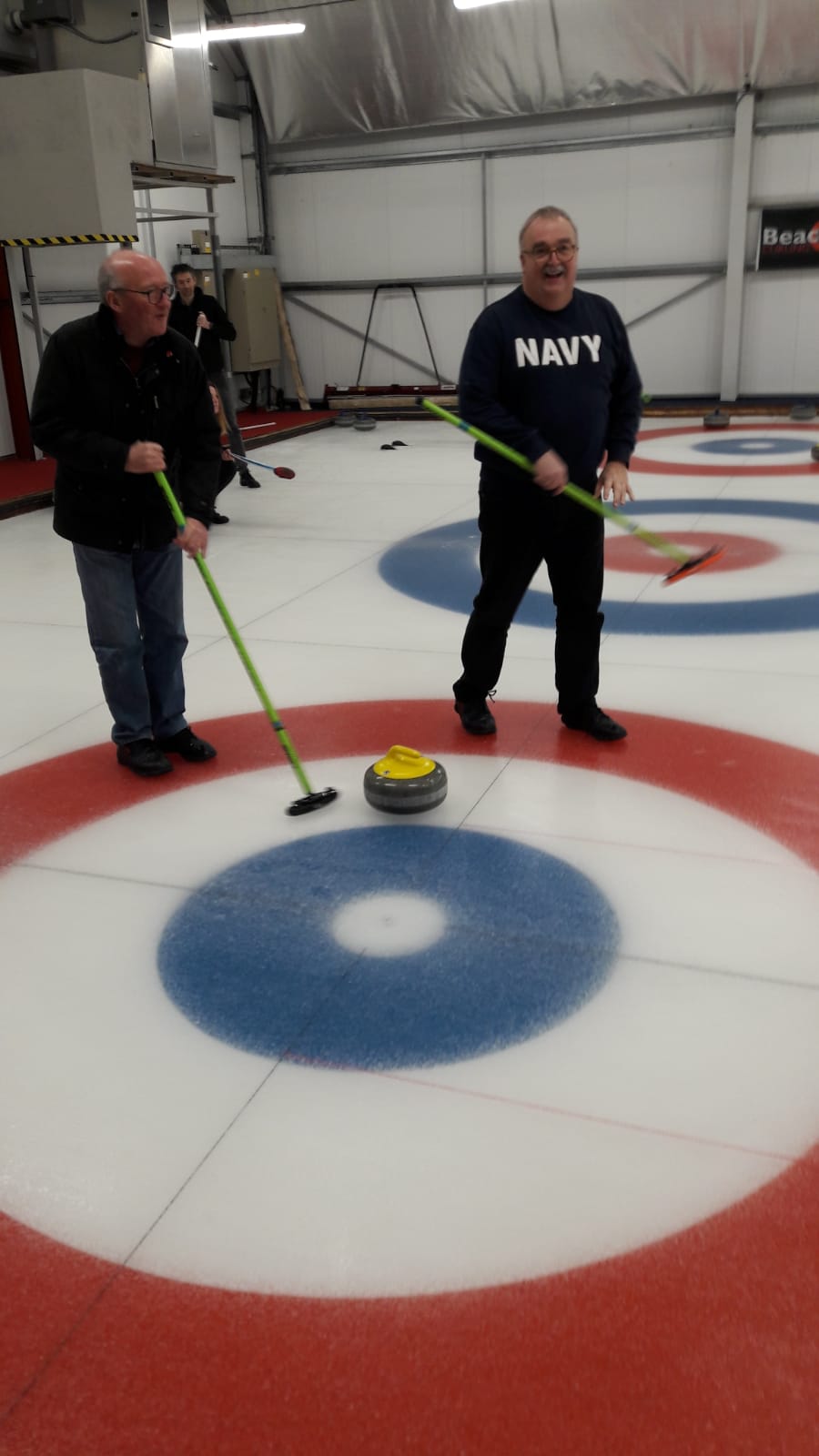
On our second visit to England's only curling rink RSC Belgium has recorded a famous victory! Our return visit to the RSC Kent organised event at Fenton's curling rink near Tunbridge Wells was on Saturday 8 December and victory was secured with the final stone.

RSC Kent local section have been holding an annual festive curling event for a number of years and invited RSC Belgium to participate for the first time in 2017. The invite was repeated this year.

This year's RSC team consisted of section chairman Tim Reynolds (pictured 'in action' below), recent ex-section secretary Becki Scott (now a resident of Kent), Helen Lee (Mrs Chairman), Antony Lee Reynolds (Chairman's son) and two locally recruited 'ringers' (friends of the chairman) Sally Wellsteed and Richard Hucker (also pictured below).


Curling has been an Olympic Winter sport since 1988 and is one of the few events everyone can try. It is fair to say that curling is a game that is easy to play, but may take several lifetimes to master... however it was great fun and RSC Belgium participants aim to return again!

The game is suitable for young and old, and can be played as a social or competitive sport. As England's only dedicated ice curling rink, Fenton’s three lanes offer a unique opportunity for people to give curling a go or just meet up for some fun. And there was very little slipping over thanks to the special 'sticky' shoes supplied by the venue.

Warm welcome
The Kent section have been organising a curling event for a few years now and the main protagonist, Dave Alker, has seen the event grow and grow in recent years. For 2018 demand was such that he had booked three two-hour sessions. A fine lunch of Lasagna and salad followed by Lemon Drizzle cake was included and the rink has its own cash bar too.

Participants were a mixture of ‘regulars’ i.e. those who had embarrassed themselves on the rink in previous years, and newcomers. The participants ranged from 18 to 80 and included RSC members, guests and partners as well as ex-RSC staff members and, of course, our Belgian contingent. Everyone thoroughly enjoyed the experience.

Dave and the Kent section are already preparing for the 2019 event with the venue provisionally booked for Saturday 30 November - appropriately on St. Andrews Day. See you there?

Cheers to CO2

On the evening of Thursday 29 November RSC Belgium was delighted to welcome Dr César Alejandro Urbina Blanco from Ghent University to St. John’s International School in Waterloo to talk to us about some fascinating developments in the chemistry of using carbon dioxide (CO2) as a chemical feedstock. César is currently working as a Post Doctoral Researcher in the Laboratory for Chemical Technology at Ghent on sustainable chemistry and the utilisation of CO2.

César told the story of that little molecule responsible for the bubbles in your fizzy drink, which is also the main chemical culprit responsible for global warming and climate change. He described how CO2 is all around us, how we produce it directly or indirectly every time we switch on a lamp, buy a product or even breathe! Using fossil fuel for energy and as the main feedstock for the chemical industry has caused the release of unsustainable amounts of CO2 to the atmosphere.


So how do we solve the global CO2 problem without compromising our lifestyle? Chemistry, of course! César outlined the many ways in which chemists are now looking to turn CO2 back into valuable products from fuel to foam for mattresses.

Passionate
Cesar is a passionate chemist and has been identified as a future leader by the American Chemistry Society. He gave an impassioned speech at the Science March in Brussels last year. A native of Venezuela, César studied Chemistry in Universidad Simón Bolívar in Caracas including a final year project at The Institute of Chemistry of Organometallic Compounds in Florence, Italy under supervision of Prof. Maurizio Peruzzini.


He completed his PhD in Organometallic Chemistry and Catalysis at the University of St Andrews in Scotland where he worked on the development of commercial olefin metathesis catalysts under supervision of Prof. Steve Nolan – now also at Ghent. César then moved as a Postdoctoral Researcher in the field of Green Chemistry to RWTH Aachen University in Germany with Prof. Walter Leiner and Jürgen Klankermayer, before coming to Belgium.