Tuesday, 3 October 2023

Current Chemistry investigates the Movies

On 28 and 29 September RSC Belgium welcomed Dr John O'Donoghue of Trinity College Dublin and colleagues to Brussels to deliver some Current Chemistry Investigators school workshops and give a reprise of his 'Chemistry in the Movies' talk at our 2023 Chemistry Challenge prize giving event on the evening of  28 September.

The idea of a workshop tour with John had been in the RSC Belgium planning for a few years now, but various interruptions - not least due to the COVID pandemic - had got in the way. However, despite the last minute intervention of Storm Agnes, we eventually were able get him, along with colleagues Dr Fiona McArdle of the Atlantic Technological University Sligo and Dr Natalia Garcia Domenech from Trinity, to Brussels in 2023.

Current Chemistry Investigators 

John (pictured below) and the team conducted four workshops during their time in Belgium: two at the British School of Brussels (BSB) in Tervuren on 28 September and two at St. Johns International School in Waterloo on 29 September.

The workshops provided the students with hands-on activities based on simple electrochemistry and electroanalytical concepts through tangible scientific role models. It also provides researchers with valuable and beneficial experience in science communication, to help them develop skills to share their research to wider audiences. The project looks to create an appreciation for the role of chemistry research in everyday life, increasing interest in this vital area for the benefit of everyone’s future.

The Current Chemistry Investigators initiative is an informal education and public engagement project developed by Trinity College Dublin and the Atlantic Technological University Sligo to spark conversations with schools and community groups about the science of energy storage and chemical analysis. The project was developed through funding provided by the Science Foundation Ireland.

Cinematic science

On the evening of 28 September John gave us an updated and in-person version of his 'Chemistry in the Movies' lecture in the Brel Theatre at BSB.

This mixed media talk will took a scientific and filmographic look at how chemists and chemistry have been portrayed in the movies and on TV. Short clips and graphics were used to talk about the topic in an engaging and light-hearted format. The movies chosen for this discussion are based around a number of themes like problem solving, plot devices, chemical companies and people. Details about where and how to access the relevant movies were  also be provided (Netflix, Disney, Amazon, Youtube, Apple etc).

About John

John is the RSC Education Coordinator in the School of Chemistry at Trinity College Dublin. He coordinates the education and public engagement course for PhD researchers and teaches a “chemistry in society” module for undergraduate students. On behalf of the Royal Society of Chemistry he also supports trainee and established science teachers through the provision of continuous professional development workshops and the development of new teaching resources.

Monday, 2 October 2023

Chemistry Challenge 2023 results announced

The results of the RSC Belgium Chemistry Challenge 2023 were announced at our event on 28 September with Dr John O’Donoghue at the British School of Brussels (BSB) in Tervuren. This year the Challenge resumed its usual ‘in-schools’ format after two years as a virtual event due to the COVID pandemic and BSB students claimed the majority of the prizes!

For the 2023 Challenge, seven schools took part (four European Schools and three International Schools) with a total of 74 students participating. This was a most encouraging number, but still under pre-COVID levels. We look forward to increased numbers for the 2024 edition of the Challenge.

As ever, the Challenge was designed to test students’ chemical knowledge and initiative. This year most students found Section A questions particularly taxing apart from some True/False questions.

The RSC Belgium Chemical Challenge has three sections:

- A chemistry multiple choice paper (Section A)

- A structured questions on chemistry (Section B), and

- A 'Thinking Matters' paper that is not chemistry based (Section C)

The top results were as follows:

Section A - Multiple choice

First prize for this section was won by Andrei Vascan from BSB who received a €50 award.

In joint second place were Hanseo Lee (far left below) and Annette Liflander (right below) also from BSB who each won €25 and, making a clean sweep for BSB, the third prize of €10 went to Kerem Teker (left below) from BSB.

Section B - Structured questions

In this section the first prize of €50 was awarded also won by Andrei Vascan of BSB with Laura Bartelloni (pictured right below) and Marianne Moody from BSB both picking up second prizes of €25. A third prize of €10 were awarded to Fanziska Vogel (left below) also of BSB.

Section C - Thinking Matters

Breaking the trend in this section, the top prize of €50 went to Melinda Koch of European School 1 in Luxembourg (ESL1) with Marianne Moody also claiming a €50 prize for BSB.

In second place was Alec Muller (pictured left above) of BSB winning him €25 and two third prizes worth €10 each were awarded to Annette Liflander and Aimee Willey (right above) both from BSB.

The Keith Price Prize

With a first prize in both Section A and Section B, this year's Keith Price Prize was claimed by Andrei Vascan (pictured below with RSC Belgium chair Prof Bob Crichton), who received an additional €100.

Well done to everyone who took part in this year's Chemistry Challenge! Every student that entered the competition receives a certificate of participation. And, of course, we will be running the Challenge again in 2024 and look forward to further widening participation!

A Wonderful Walking Tour of Ghent

On Saturday 9 September, RSC Belgium members and friends took part in a wonderful walking tour in the late summer sunshine around the Belgian city of Ghent. Our guide, Dr Paul Snell, helped illuminate the history and scientific and industrial heritage of the city often described as the 'Venice of the North'. And we also visited the relocated RSC Chemical Landmark for August Kekulé.

Our tour group met up at 10am for coffee and an introductory briefing from Paul at the Limerick Bookshop close to Ghent St Pieters station. Then it was 'all aboard' a tram to the centre of Ghent.

Our first port of call was to visit the Kekule Landmark that was presented to Ghent University by then RSC President David Phillips in November 2011. The landmark recognises Kekule's pioneering work on structural and organic aromatic chemistry whilst at Ghent and was originally placed close to the site of his laboratory. The Landmark had been re-sited to be more accessible to the public during weekdays. At the weekend, however, the old town centre campus is not open to the public, but RSC Belgium member Prof. Bruno Linclau from Ghent University was able to get us access.

The photo above shows the plaque with, from left to right, Dr Denis Comeyne of the Royal Flemish Chemical Society (KVCV) and Chair of the KVCV/ Antwerp University Kekule Cycle seminar series, our section chair Prof Bob Crichton, and Prof. Bruno Linclau.

Of mustard and machines

Having viewed the plaque Paul then led us around the town centre pointing out buildings of interest and many aspects of the city's past and present glories including the famous Tierenteyn Mustard shop. Some of the party bought a pot of this revered Flemish condiment that has a heat point somewhere between French and English mustard.

Our tour eventually brought us to Ghent's Industrie Museum where we learned about an audacious piece of industrial espionage that helped build Ghent's economy in the Industrial Revolution. In 1801, Lieven Bauwens smuggled a spinning mule and steam engine out of the UK to help set up the textile industry in Flanders. At the time such a crime was punishable by death. Bauwens was later elected Mayor of Ghent. The spinning mule that was brought to Ghent is in the Industrial Museum, which also boasts a very fine view over central Ghent.

After the industry museum, the tour moved onto a leisurely lunch at Meme Gusta where home-cooked Flemish fare was on offer including a very fine Stoofvlees (Flemish meat stew) with, of course, frites.  

GUM

After a brief pit stop at one of Ghent's many excellent chocolatiers - Hilde Devolder - we boarded another tram to head for the new Ghent University Museum (GUM) situated in the Botanical Gardens in Citadel Park.

GUM displays an eclectic selection of items from all the University's departmental collections including Kekule's stick and ball models of benzene (see below). GUM is well worth a visit, as is the Botanical Gardens close by.


After a highly entertaining and informative day, our party took a farewell 'apero' in the early evening sunshine close to St Pieters station before heading on our various ways home.

Many thanks to Paul Snell for organising the itinerary - a great time was had by all!

Friday, 2 June 2023

New Horizons in synthesis: click chemistry and beyond

On the evening of Thursday 20 April from 19h30 RSC Belgium welcomed Professor Ari Koskinen, Emeritus Professor of Organic Chemistry at Aalto University, Finland to talk to us about ‘New Horizons in synthesis: click chemistry and beyond’. The event was held at the British School of Brussels in Tervuren and was followed by an opportunity for RSC members and friends to network and ask informal questions of the speaker over drinks and snacks.

A central feature of chemistry is to produce novel connections between atoms, in other words chemical synthesis. The state of the art of organic chemical synthesis is defined by the complexity of the target structures one can produce in an efficient manner. Especially during the past two decades, different economies of synthesis have taken a central role in the development of synthetic chemical strategies. Thus atom economy, step economy, redox economy are valid targets for synthesis research.

‘Click chemistry’ and biorthogonal chemistry are timely subjects and Ari took us through a brief history of organic synthesis and introduced us to the latest trends in this important part of chemistry. 

The 2022 Nobel Prize in Chemistry was awarded to Carolyn Bertozzi, Morten Meldal, and Barry Sharpless for the development of click chemistry and bioorthogonal chemistry.

As usual, the session was recorded and you can access it direct via the RSC YouTube channel here or via the embedded video below.

Our speaker

Professor Ari Koskinen (pictured below) received his M.Sc. (Chem. Eng.) in 1979, his Licentiate in Technology in 1982 and his Doctor of Technology in 1983 from the Helsinki University of Technology.

After postdoctoral studies at the University of California, Berkeley he accepted an appointment as a Project Leader in New Drug Development at Orion Corporation – Fermion, Finland where his research group was among the first in Scandinavia to adopt computer aided drug design as well as computerized database handling protocols in new lead identification. Returning to academia, he joined the University of Surrey as a lecturer in 1989 and was then appointed as Professor of Chemistry (especially Synthetic Organic Chemistry) at the University of Oulu, Finland in 1992, and transferred to the Helsinki University of Technology in 1999 (Aalto University since 2010) as Professor of Organic Chemistry.

Prof. Koskinen is a member of the Finnish Academy of Sciences and Letters since 2003. He is the author or co-author of some 190 publications, 15 patents and three books. He retired from active academic work in October 2021, but as emeritus professor, he keeps his finger on the pulse of organic chemistry through activities in IUPAC (Division of Organic and Biomolecular Chemistry) and EuChemS (secretary, Division of Organic Chemistry).


Monday, 17 April 2023

Catalyzing the road to sustainable e-fuels

On the evening of Thursday 23 March 2023 RSC Belgium welcomed Professor Damien Debecker from UCLouvain to the British School of Brussels in Tervuren to talk about ’CO2 and H2: catalyzing the road to sustainable e-fuels?’ Professor Damien Debecker is a professor within the Faculty of bio-science engineering at UCLouvain and is currently holder of a Francqui Research Professor chair.

As we all know the mitigation of net CO2 emissions is currently an absolute priority challenge for society for which various strategies must be implemented in parallel. One useful technology, which falls under the umbrella of the Carbon Capture and Utilization (CCU) concept relies on the catalytic hydrogenation of CO2 to methane, methanol, or higher hydrocarbons.

When methane is targeted, this process is called methanation or the Sabatier reaction. Prof Debecker took us through recent developments in the design of highly active methanation catalysts and then placed these developments in a more general context, questioning the sourcing of both CO2 and H2 and highlighting the fundamental role of renewable electricity in so-called sustainable processes.

The talk covered a number of issues relating to sustainable chemical processes, future energy production and the sense (or non sense) of certain proposed solutions. A lively Q&A session follwoed teh talk and continued during moe informal networking afterwards.

The session was recorded and you can access it direct via the RSC YouTube channel here or via the embedded video below.


Friday, 14 April 2023

BSB at Top of the Bench Final

Our 2022 Belgium Top of the Bench champs – Team Sodium from the British School of Brussels (BSB) – competed in the Royal Society of Chemistry’s 2023 Top of the Bench national final on 25 March at the University of East London (UEL). The BSB team were the only non-UK team in the 31 competitors. The competition tests the chemistry knowledge of 14–16 year-old students through written and practical exercises.

Students had to complete a 40-minute chemistry knowledge exam in pairs, followed by a 90 minute hour practical team exercise in UEL’s labs. The theme of the final was sustainability with a practical challenge on sustainable energy that included a calorimetry task, density determination and finally an analysis of some possible “future fuels”. 

The teams also had a talk from Tony Raynham, the course leader for the University of East London Chemistry department, about the course (a new course only just set-up), his life history and journey about how he got to where he is now and then a talk on apprenticeships from an RSC speaker. 

Tony Raynham said that UEL was delighted to host the talented young chemists in the Bioscience department.

Unfortunately, BSB did not win; Winchester College (winning team pictured above) took top place. The winning team received a trophy and Amazon gift vouchers, and will be sent £500 for their school to spend on science equipment. The first runners-up, four students from Colchester County High School for Girls, received Amazon vouchers. Hannah Addiscott from The Grange School was awarded the Jacqui Clee Award for the most outstanding individual contribution.

BSB chemistry teacher and RSC Belgium committee member Jonathan Norris escorted the BSB party and commented: “The students really enjoyed themselves, despite a long day.” The BSB team made the trip to and from London in a day.

Despite not winning all the students came away with a free t-shirt and a periodic table and the accompanying teachers got a thermochromic mug, a RSC lanyard, and a fetching RSC tote bag.

Next year’s final will be in Edinburgh and RSC Belgium will be planning to send a team as usual.

Friday, 17 February 2023

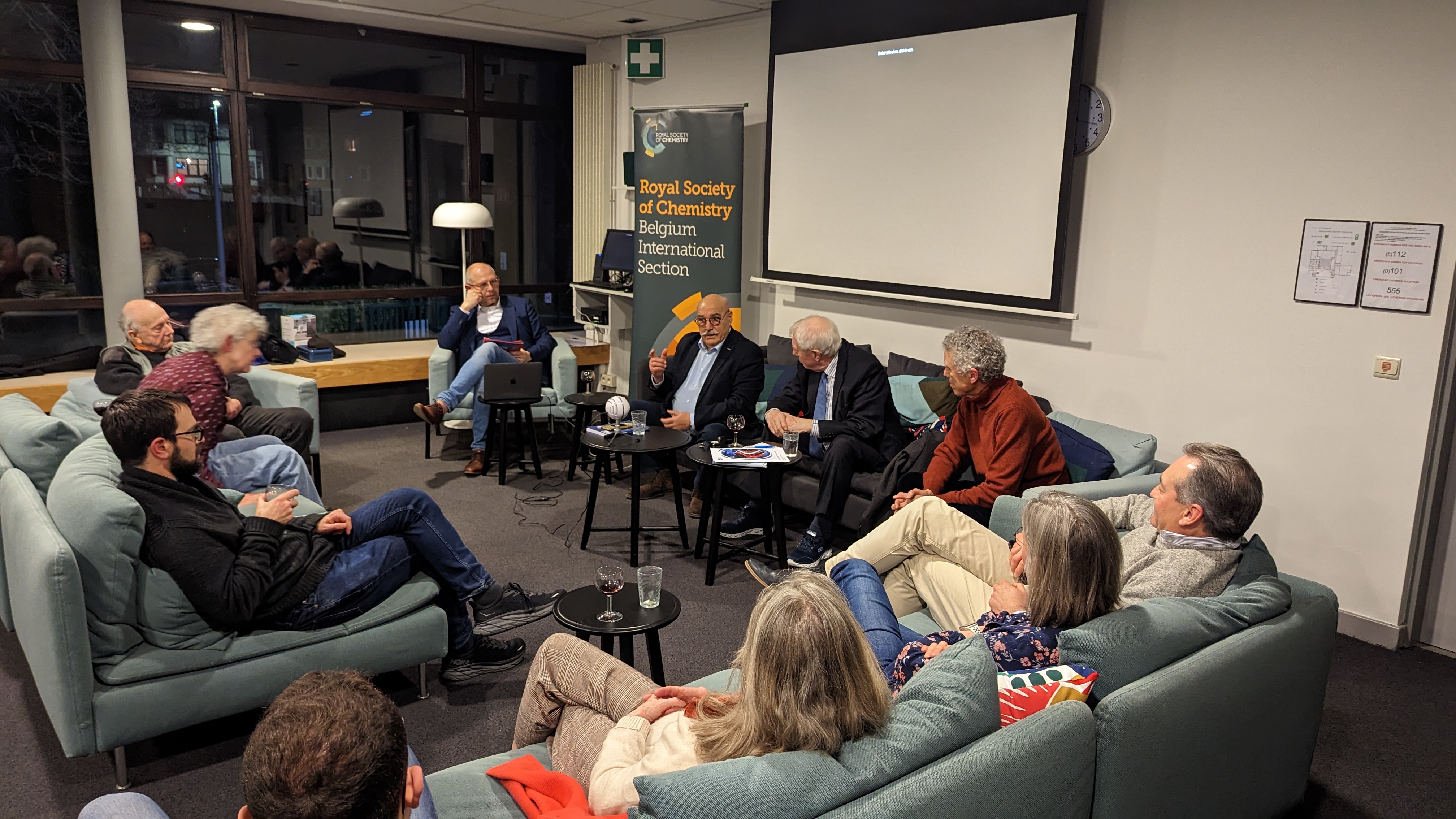
How to make Urban Transport more Sustainable?

On the evening of Thursday 9 February 2023 the section kicked off its 2023 programme of events with a Café Chimique on 'Sustainable Transport' at the British School of Brussels in Tervuren. 

For our society,  one of the greatest challenges is to plan and invest wisely for sustainable transport. Transport plays a crucial role in economic development by providing access for people to education, markets, employment, recreation, health care and other key services not to mention enabling the movement of goods. Enhancing mobility for all parts of society is one of the most important preconditions for achieving economic, environmental and social goals.

In reality, transportation systems in most urban areas are far from ideal. Motorised modes still dominate and traffic congestion is ubiquitous making a significant impact on local and national GDP, degrading the urban environment and affecting citizens’ health and quality of life.

What are the solutions? What does a sustainable transport system look like? How can it be achieved? How will it be fuelled? What new or existing technologies are needed to make such systems happen? Where can the chemical sciences help? And what else is needed in terms of cultural or behavioural change by citizens?

For the debate RSC Belgium members and friends were joined by two speakers to (hopefully) find some answers to these questions and more. Section chair Prof Bob Crichton introduced the two speakers.

Prof Samuel Furfari is a recognized authority on energy policy based in Brussels. Following a 36 year career with the European Commission's DG Energy, he was appointed as a professor of geopolitics of energy at various universities including at the Université Libre de Bruxelles. He is President of the European Society of Engineers and Industrialists.

After 21 years at the UK Transport Research Laboratory, Paul Kompfner moved onto the European stage in 1992, to help set up Europe's first multi-sector partnership for deployment of intelligent mobility. Now independent following 25 years at ERTICO-ITS Europe, he is working with various projects to promote sustainable mobility of people and goods in cities

Our two speakers provided short introductory talks that was followed by an audience led Q&A discussion. As with our previous Cafe Chimiques the audience will be seated in a relaxed café-style format and a gratis bar and snacks were throughout  the evening. 

The presentations and debate were recorded is now available via our YouTube channel or below. Enjoy!