Tuesday, 25 September 2018

2018 Chemistry Challenge Winners announced, top prize shared!

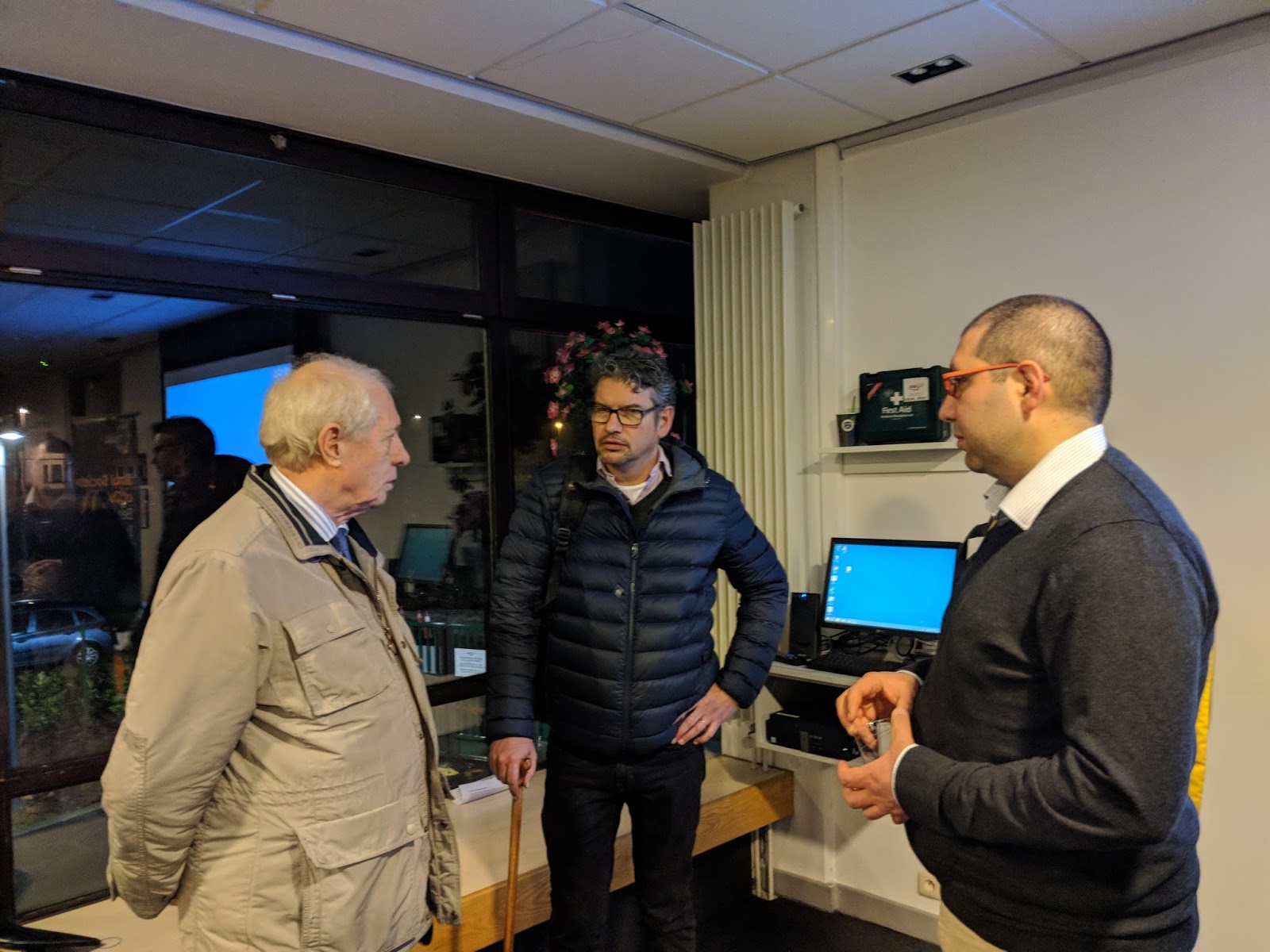
The results of the RSC Belgium Chemistry Challenge 2018 were announced and the talented prize winners picked up their winnings at a special RSC Belgium event with Prof David Cole-Hamilton, past president of EuChemS, the European Chemical Society, on the evening of 20 September at the British School of Brussels (BSB). Once again we received some 100 entries from international and European schools in Brussels and beyond for this testing challenge of young people's chemical knowledge and initiative. And for the first time ever we had a dead-heat for the Keith Price Prize for best overall performance in terms of chemical knowledge.

The RSC Belgium Chemical Challenge has three sections:
A/ A chemistry multiple choice paper
B/ A structured questions on chemistry, and
C/ A 'Thinking Matters' paper that is not chemistry based

And the top results were as follows:

Section A: Multiple choice
First place was taken by Faiz Haris Osman from BSB with second place shared by Thomas Groom of BSB and Vincent Sietses from St. Johns International School. Third place was a three-way tie between Linxiao Chen from BSB, Ignacia Bricchi from St. Johns and Maria Tencheva from the European School Brussels IV at Laeken. Some of the prize winners are pictured below with our special guest Prof. David Cole-Hamilton.


Section B: Structured Questions
In this section first prize was awarded to Vincent Sietses from St. Johns with second prize shared by Lara Melloul from the International School of Brussels (ISB) and Faiz Haris Osman of BSB. Two students also shared the third prize: Thomas Groom of BSB and Luan Cruz Pitanattero of the European School at Mol.


Section C: Thinking Matters
Here first place was awarded to Faiz Haris Osman from BSB with Bernard Benz from BSB taking second prize and third place shared between Shahriar Hossain from St. Johns and Natalie Kopp from the European School Brussels III at Ixelles.


Keith Price Prize
For the first time ever, we had a dead-heat for the top spot, the prestigious Keith Price Prize for the best best overall score in the chemistry focused sections (A and B). The joint winners were Faiz Haris Osman from BSB and Vincent Sietses of St. Johns.


First prize winners in each section received €50, second €25 and third places €10 with the winners of the Keith Price Prize receiving an additional €100 each.

Well done to everyone who took part in this year's Chemistry Challenge! Every student that entered the competition receives a certificate of participation. We will be running the Challenge again in 2019.

A Devilish Good Time at Duvel

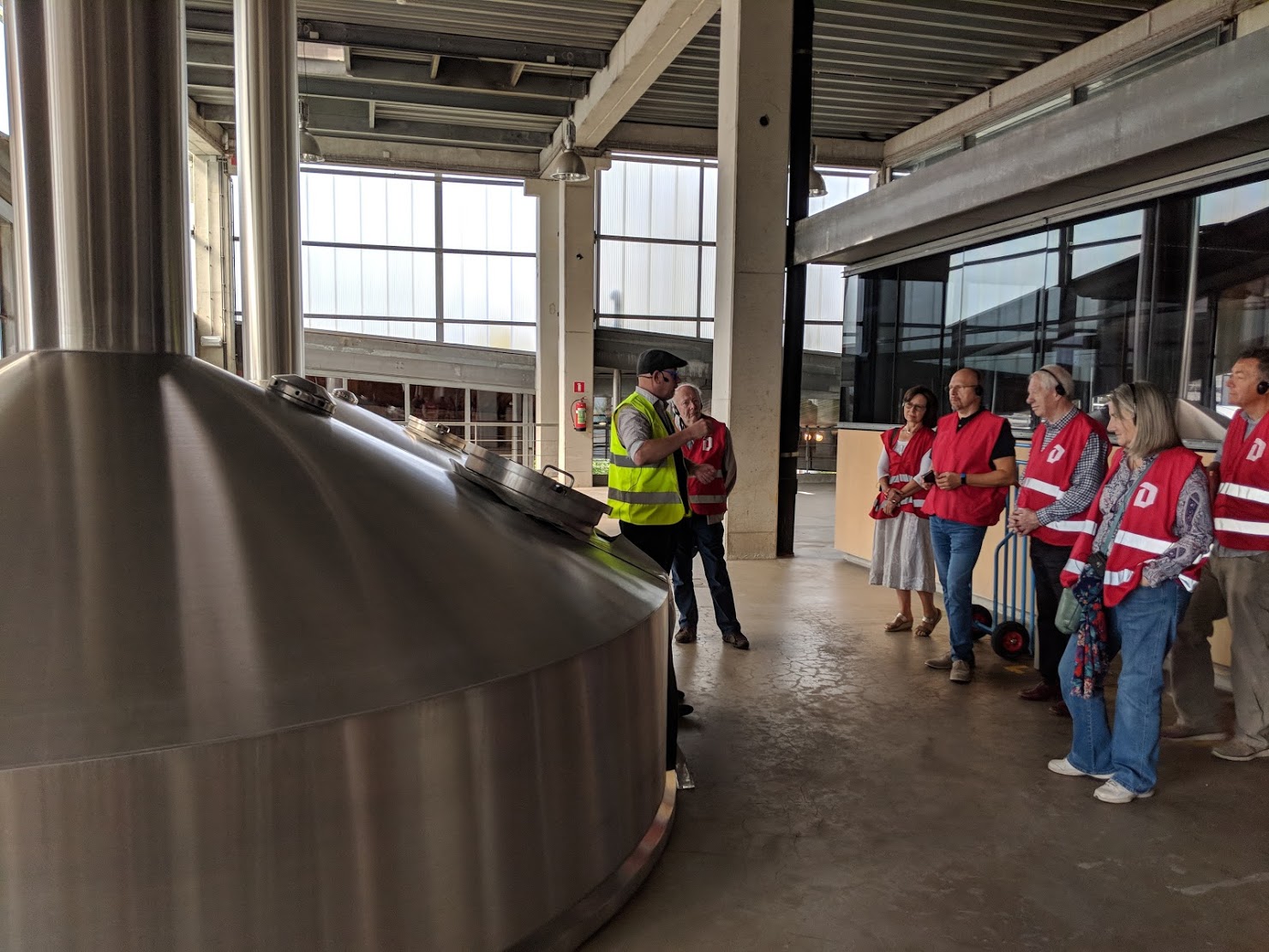
A sunny Saturday morning greeted the group of RSC Belgium Members and friends who ventured out to visit the Duvel Moortgat Brewery in the Flemish town of Puurs on 15 September 2018. The group were treated to an informative and entertaining guided tour of the brewing and bottling operations of this fiercely independent family business.


The Duvel story started in 1871 when Jan-Leonard Moortgat and his wife founded the brewery on their farm. The beers were developed via a trial and error basis but sales rose and by 1900 Jan-Leonard's two sons Albert and Victor had joined the firm.

A Scottish connection
The First World War brought many English' beers to Belgium with the British army and Albert decided to create a special beer based on the (then current) English model.To do this he needed to acquire specific strains of yeast so in 1918 travelled to the UK, but met some resistance from English brewers. He eventually obtained a sample of yeast from a Scottish brewer - and this strain is still used today to brew Duvel beer.


Using the new yeast the two brothers perfected their recipe and launched it as 'Victory Ale' to mark the end of the war. The name lasted until 1923 when following a 'tasting session' with local dignitaries a shoemaker Mr van De Wouwer was so amazed at the beer's potency that he exclaimed 'This is a real Duvel (Devil)!' And the name stuck.

The famous tulip-shaped Duvel glass first appeared in the late 1960s and was the first of its kind able to take a full 33 cl bottle and allow a more complete experience of the beer's aromas and flavour.


Today the fourth generation of the Moortgat family is keeping the company at the forefront of brewing and expanding their sale internationally while ensuring that quality and sustainability are guaranteed.

Following our guided tour and the group enjoyed a glass or two of the Duvel's production and some other very interesting beers with the help of the skilled beer wranglers at the Brewery's bar.


For more information on the Duvel Brewery and available tours, please visit their website. Highly recommended.

Monday, 18 June 2018

A Trip to TrainWorld

On Saturday 16 June 2018 a select group of RSC Belgium members and friends were treated to a guided tour of the (relatively) new TrainWorld museum adjacent to the grand old station at Schaarbeek in Brussels. Following our experience we can highly recommend a trip to TrainWorld!


The guided tour took over two hours and was full of new facts and fascinating information. How many train stations are there in the grounds of the royal place at Laeken? How many oak trees were required to be felled to provide the sleepers for every mile of rail road in the 19th century? (Answers below)*.


Belgium was a very early adopter of rail technology with the first commercial (and nationalised) railway line in continental Europe opened between Brussels and Mechelen in 1835. Initially the Belgians imported UK technology but rapidly 'copied' and developed their own engines becoming the leading global exporter of railway equipment during the 1800s.


The museum itself incorporates ancient and modern. The tour starts in the impressive interior of the old Schaarbeek station and then enters four massive modern halls full of old engines and railway memorabilia with something to amuse visitors of any age and degree of interest in trains.


*There are three railway stations in or under the palace grounds. 880 oak trees were needed per mile!

Chemical Bonding in the 21st Century

On Monday 28 May 2018 a full day symposium was organised by the Vrije Universiteit Brussels (VUB) in honour of  the visit to Brussels of Professor Roald Hoffmann, Nobel Laureate in Chemistry in 1981. The theme of the symposium is central in Hoffmann’s work: the Chemical Bond. 


The aim of the Symposium was twofold:in the morning session, the audience got an in-depth impression of Hoffmann’s work, ideas and vision on the chemical bond in a special two hours lecture with a pedagogical perspective from Prof Hoffmann. This was a veritable tour de force from the distinguished that was informative and entertaining in equal measure.


Matthias Bickelhaupt (VU Amsterdam), a former postdoc with Hoffmann, closes the morning session discussing “Chemical Bonding in Transition States”.

In the afternoon session, the context is different: six young but already renowned scientists from six Belgian universities highlighted their work, offering Roald Hoffmann and the audience an impression of the present status of Quantum and Theoretical Chemistry in Belgium.

The afternoon session included two contributions from RSC Belgium members: Jeremy Harvey of KULeuven who described his work on chemical bonds in dynamics and microscopy and Prof Benoit Champagne from the University of Namur who talked about his work on molecule, polymers and supramolecular assemblies.

Wednesday, 25 April 2018

Chemistry and Music: a Popular Combination!

On Thursday 19 April 2018 RSC Belgium members and friends were treated to an likely combination of Chemistry and Music at St Johns International School with Professor Adrian Dobbs of Greenwich University. This evening talk, chemistry demonstration and musical performance attracted a large and enthusiastic audience to the Music Room and its Grand Piano.


During the talk entitled 'Chemistry and Music: an unlikely combination?' Prof Adrian Dobbs, accompanied by Sophie Brewer, discussed the historic links between music and chemistry, including how chemistry has contributed to the manufacture of musical instruments and how many famous musicians have had links to chemistry and much more! Did you know that quintessential English composer Edward Elgar was a keen amateur chemist. Or that Russian compose Borodin was torn throughout his career between the professions of chemistry and music.


We learnt about the chemistry behind Stradivarius's violins and guitar strings and Adrian and Sophie performed a number of musical pieces with Adrian playing the piano and Sophie on flute and violin.


In addition Professor Dobbs recruited volunteers from the audience to participate in some demonstration chemistry including making your own polymers and simple electroplating. All using chemical substances commonly found in the home.

All in all the event proved that Chemistry and Music was a very interesting combination and was greatly appreciated by our audience.

Wednesday, 4 April 2018

CRISPR-Cas9 gene editing technology

Our 2017-18 programme continued on Thursday 22 March with a fascinating insight into the CRISPR-Cas9 gene editing technology with Prof Bernard Hallet from the Universite Catholique de Louvain in his talk: 'Genome Editing by CRISPR-CAS9: Turning a Bacterial Trick into a Biotechnology Revolution”.

Prof Hallet (pictured below) described the biological and chemical basis of the CRISPR (Clustered Regularly Interspaced Short Palindromic Repeats) technique and how the development of targeted genome editing systems, such as CRISPR, and their applications has moved forward enormously in the last decade.  In the last five years the field has undergone a quantum leap with the introduction of CRISPR-Cas9, the bacterial immune system which can be used to edit genomes on demand.

Bernard outlined how this serendipitous discovery that bacteria contained DNA sequences which were repeated, and interspersed with unique sequences, latterly identified as viral DNA, derived from viruses that had previously infected the bacteria.


It was then found that close to the CRISPR sequences, genes were located coding for CRISPR-associated proteins (Cas), which have nuclease activity. Together with small guide RNAs (crRNAs) which have been transcribed from the CRISPR locus, one or more Cas proteins form ribonucleoprotein targeting complexes, with each contain a single guide sequence. The Cas nuclease (usually Cas9) then cleaves the target DNA, marked for degradation by base-pairing with the crRNA.

In 2012, Emmanuelle Charpentier and Jennifer Doudna proposed that the CRISPR-Cas9 system could be used for programmable gene editing, an idea that has since been further developed by many research groups for potential applications ranging from creating smart model systems for fundamental protein research to enabling bio-engineers to modify crops and farm animals, and translational scientists to develop novel treatment approaches for inherited and acquired disorders for which curative treatment options are not currently available.


This fabulous CRISPR-Cas9 story provides the perfect example of how basic bacterial research has moved the whole scientific community towards the next biotechnological revolution and sparked an extended Q and A after the talk itself.

Charpentier at Louvain-la-Neuve
The title Doctors Honoris Causa will be awarded by the Universite Catholique de Louvain to Prof  Emmanuelle Charpentier of the Max Planck Institute for Infection Biology, Berlin, Germany for her discovery of the CRISPR/Cas9 genome editing system and to Prof Malcolm Bennett University of Nottingham, United Kingdom for his work on the root system of plants at a ceremony on 18 April.

The ceremony will take place at the UCL campus of Louvain-la-Neuve (Life Sciences Institute, ISV) on Wednesday April 18. For more information on this event and to register visit the UCL-ISV website.

Sunday, 4 March 2018

An Evening with Professor Sir Martyn Poliakoff

On Friday 23 February, RSC Belgium was delighted to host an informal evening with Professor Sir Martyn Poliakoff. The event took place at the British School of Brussels and was a hugely informative and entertaining soiree with one of Europe's most eminent chemists and science communicators.


Staged in a Cafe Chimique style, with refreshments available throughout the evening, Prof Poliakoff first gave a short talk on his work and career covering his research interests focused on supercritical fluids, continuous reactions and their applications to Green Chemistry.  He also talked about the Periodic Table of Videos, which he hosts.


Prof Poliakoff then answered questions from the audience for over an hour before further informal questions at the end. Our audience for the evening ranged from six to seventy and an excellent time was had by all.

During the evening we took a collection to support our Norman Lloyd Scholarships at Cardiff University and raised a further EUR 200 for the fund. Many thanks to all who contributed.


About Sir Martyn
Sir Martyn Poliakoff CBE FRS FREng studied at King's College, Cambridge, gaining his Ph.D. in 1973 on the Matrix Isolation of Large Molecules. Following time at the University of Newcastle he joined Nottingham University in 1979. He is Honorary Professor of Chemistry at Moscow State University. He is a Fellow of the Royal Society, the RSC and the IChemE and was awarded CBE in 2008 for "Services to Sciences", and knighted in 2015 for "Services to the Chemical Sciences". He was Foreign Secretary and Vice-President of the Royal Society from 2011 to 2016.

A taster for the Periodic Table of Videos is below - featuring Hydrogen.