Thursday, 31 March 2011

Euroschools Science Symposium

RSC Belgium was busy mid-March supporting the European Schools Science Symposium (ESSS) that took place this year from the 20th to 23rd at the European School Brussels II at Woluwe and at Eurocontrol. RSC Belgium provided speakers and sponsored a prize for the best chemistry-related entry.

As well as involving local RSC Belgium members, we were able to invite the RSC's interim CEO, Dr. Robert Parker, to Brussels to deliver a plenary address.

The ESSS is an annual opportunity for students from the 27 schools of the European School system to show off their scientific expertise. The European Schools system was established to provide native language teaching for the children of employees of the European Institutions. There are four schools in Brussels and the others are spread around Europe close to other major EU agencies from Bergen (NL) to Varese. In all 68 student projects were exhibited and described at the sysmposium.

Presentations and prizes
RSC Belgium attended the opening event on Sunday 20 March and provided two speakers. RSC interim Chief Executive Robert Parker (below) gave an entertaining after dinner address on 'Our future - chemists of the next generation'.


Before dinner RSC Belgium secretary Dr. Ian Carson had given a presentation on 'Science, Serendipity and Intrigue - the story of the modern potato crisp bag'.

The next two days were taken up with poster and oral presentations of the students' work at Eurocontrol. The Monday session was opened with some high-level speakers including EU Research Commissioner Maire Geoghegan-Quinn and Eurocontrol boss David McMillan. The symposium closed on Wednesday with prize giving and a presentation from RSC Belgium Chairman Prof Bob Crichton on 'The Powerful Potential of Chemistry'.

Mol winners
The winner of the RSC Chemistry prize was the European School at Mol in Belgium. The winning team - whose project featured a study on chewing gum - are pictured below with RSC Belgium Chairman Bob Crichton and Woluwe Headmaster Richard Galvin (far right of picture).

Congratulations to the Mol school and many thanks to section secretary Ian Carson who was the prime mover for the section's involvement with this initiative. Some of the RSC Belgium team involved are pictured at the opening Sunday event below - from left to right Robert Parker, Tim Reynolds, Bob Crichton, Ulrica Grankvist-Nybacka (deputy director of the secondary school at Woluwe) and Ian Carson.


Wednesday, 30 March 2011

Chemie et energie...detonante!

RSC Belgium's annual demonstration lecture series for International Year of Chemistry (IYC) got off to an explosive start on Tuesday 29 March with two events for schools at the Universite Catholique de Louvain (UCL) site in Woluwe, Brussels.

The lectures given by Prof Istvan Marko and his intrepid assistant Fabbio Lucaccioni (see below) certainly were well recieved by teachers and pupils and covered some explosive aspects of gas, liquid and solids plus oscillating reactions and a number of other chemical tricks.


In the morning Istvan and Fabio entertained and informed pupils from St. John's International School in Waterloo, the European School Brussels II (Woluwe) and Science Infuse.

One immediate comment from a teacher from St. Johns School was: "I want to thank the RSC for the excellent lecture this morning. Professor Marko and assistant were most entertaining and the level was perfect for the students who attended. I already know from our bus ride home that the students really enjoyed themselves and I have no doubt it will have sown some seeds of enthusiasm for our subject."


The afternoon session saw pupils from the Da Vinci International school in Antwerp, the International School of Brussels (ISB), L'Ecole International Le Verseau from Wavre and Science Infuse.

Printemps des Sciences
Prof Marko will be repeating the lecture for a public audience on the evening of Thursday 31 March and for francophone schools on the afternoon of Friday 1 April as part of the Printemps des Sciences organised by Science Infuse at UCL's main Louvain-la-Neuve campus. The evening show will feature an additional contribution from the Wavre Historical Association!

The evening public lecture has already attracted around 500 subscribers and the final francophone school show is "sold-out" at ~550 bringing this year's RSC Belgium demonstration lectures to a total audience of around 1400 - a great success.

New building
The UCL facilties at Woluwe are a new venue for RSC Belgium and worked very well. The UCL site is close to major public transport axes (Alma on metro line 1 direction Stockel, STIB/MIVB and De Lijn/ TEC buses) and close to the Brussels ring road making access easy for all. The Roi Baudoin lecture theatres are housed in the brand new Rosalind Franklin building on the site and easy to find off Avenue E. Mounier.


The section is endebted to UCL for the provision of their facilities, our colleagues at Science Infuse and to Air Liquide for gas supply at short notice. And of course to Prof Istvan Marko, Fabio and the UCL team (see above) for putting on these spectacular shows for the International Year of Chemistry.

Friday, 11 March 2011

Alzheimer's Disease

RSC Belgium members and friends got an update on progress in understanding Alzheimer's Disease on Tuesday 1st March from Prof. Jean-Noel Octave of the Institute of Neuroscience at the Universite Catholique de Louvain (UCL).

The meeting, held in the Swoosh Lounge at the British School of Brussels (BSB), attracted a healthy crowd of well over 40 who engaged in an extensive Q&A session after Prof. Octave's presentation.

Prof Octave (below left with Prof Bob Crichton) explained that the prevalence of Alzheimer's was around 1% of the population aged 60 - 64, but this doubled for every five years of age increase so at age 85 some 40% of the population would be affected. In Belgium alone this means that some 37 new cases arose every day.


Not genetic
Alzheimer's dementia results in progressive loss of brain tissue and is the most common neurodegenerative disease. It is characterized by the presence of two types of characteristic brain lesions.

The first are neurofibrillary tangles. These are intraneuronal lesions composed of paired helical filaments, whose major component is hyperphosphorylated protein tau. The second type are senile plaques, which are extracellular lesions containing an amyloid core made of Ab peptide. This peptide is produced from the Amyloid Precursor Protein (APP).

Although 1% of all Alzheimer's Disease is due to an inherited genetic cause the vast majority of cases are not. There are no known biomarkers for Alzheimer's disease and definitive diagnosis of the disease is still only possible post-mortem by microscopic analysis of brain tissue. It is possible that advanced magnetic imaging technology may make accurate diagnosis possible in vivo through direct detection of the characteristic lesions in the near future.

Protein problem
The main focus of Prof. Octave's research is on the cellular metabolism of APP, using a variety of cellular models to study the function of APP, which remains unknown. His group also uses transgenic mice that allows evaluation of the physiological relevance of the results obtained in cultured cells.

Although it is clear that our understanding of the protein chemistry underlying Alzheimer's has increased dramatically in the past few years although there is still some way to go to yield an effective intervention as the proteins involved have multiple physiological effects.

Friday, 18 February 2011

BSB test out IYC experiment

As part of the school's Charities Week the British School of Brussels (BSB) tried out the International Year of Chemistry's Global experiment. Chemistry classes on Tuesday 15 February measured the acidity of water samples for inclusion in a global database.

While secondary pupils tackled the experiment for themselves younger classes were led through the experiment by students from years 12 and 13. All classes examined four samples: rain water, tap water, distilled water and water taken from the lake in Tervuren Park close to the Royal African Museum.


The results from the experiments will be added to the IYC global database that has recently launched.

Global experiment
The International Year of Chemistry 2011 (IYC) is inviting school students around the world to explore one of Earth’s most critical resources: water. The results of their investigations will contribute to a Global Experiment, which could become the biggest chemistry experiment ever!

Under the theme, “Water: A Chemical Solution” students look at the properties of their local water and the technological solutions chemistry makes available to humanity in supplying clean drinking water.

Experiment modules can be carried out by children of all ages in schools across all continents. Results will be electronically showcased as an interactive global data map at the end of 2011, demonstrating the value of international cooperation in science.

There are four possible modular activities in the global experiment: measuring the pH of the Planet (the task BSB tackled), assessing salty waters, the Solar Still Challenge, and 'No water, No Germs'.

More information on the IYC Global Experiment can be found here.

Charities Week
The whole week of 14 - 18 February was designated as Charities Week at BSB with events and fundraising activities being staged by school staff, pupils and parents for a variety of good causes.

Tuesday 15 February was highlighted as ‘Water Day’. On the day specially branded 'Drink and Donate' water will be on sale and the school community was asked to consider 'What price would you put on clean water'. The specific aim of the day's fundraising was to provide one (or more) borehole(s) - each able to supply clean drinking water to an African school for a whole year!

BSB are Belgium TOTB champs!

Four pupils from the British School of Brussels (BSB) in Tervuren will be representing Belgium at this year's RSC Top of the Bench (TOTB) competition that takes place this coming weekend.

This year our Belgian eliminator attracted entries from 46 students at four local schools (BSB, the European School at Woluwe (Brussels II), the European School at Ixelles (Brussels III) and St. John’s International School in Waterloo). The competition was, as usual, extremely tight, but the BSB team were clear winners.

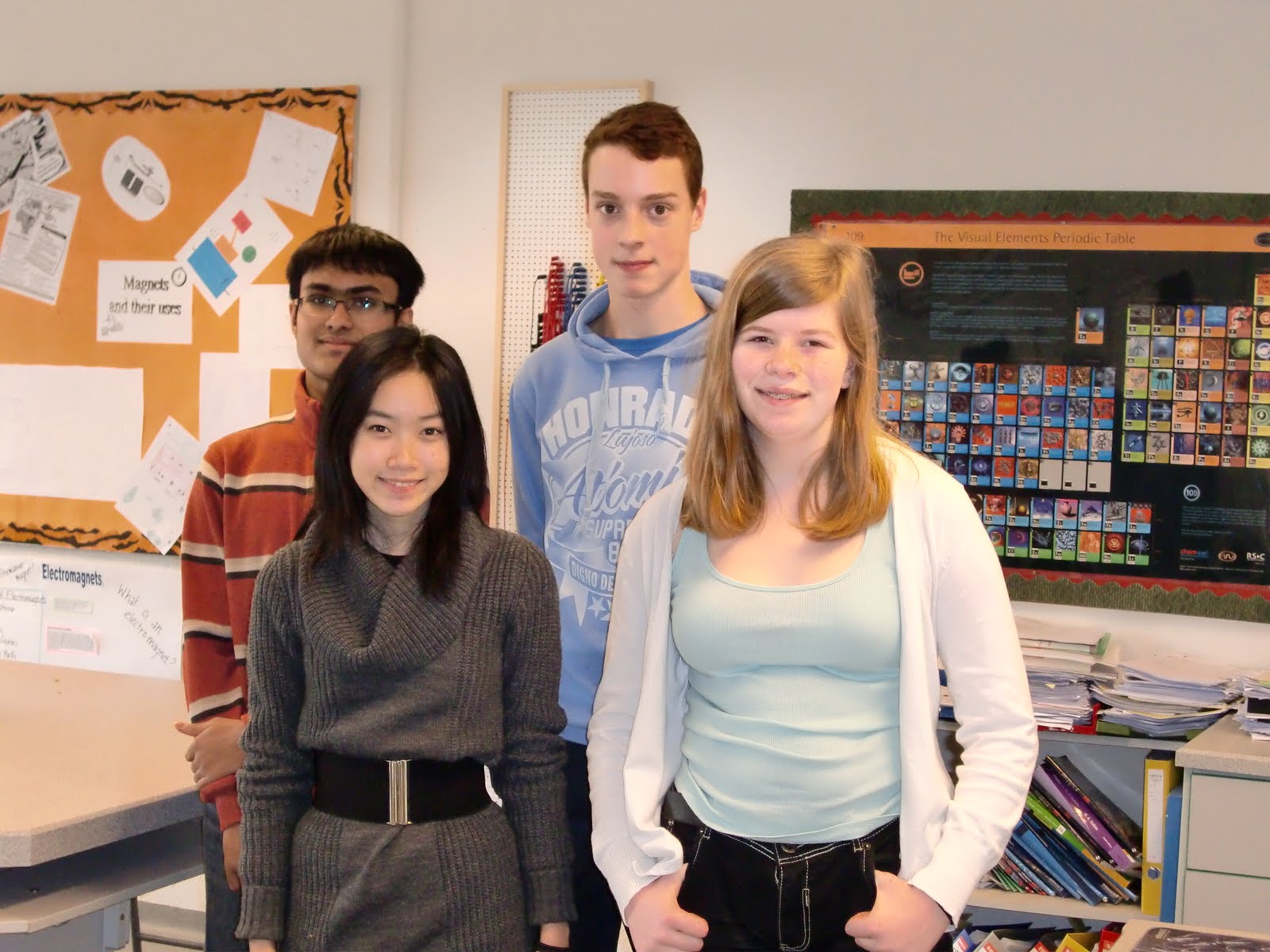
The BSB team (below) will be presented with the Belgium TOTB cup in the near future and arrangements are now under way for them to travel to the TOTB National Final in the UK. This testing challenge will pit team members Thomas, Imogen, Anandmoy and Ayako against budding scientists from some of the best UK schools.


The final takes place on Saturday 2 April at Imperial College in London. Congratulations to the BSB team and we wish them the best of luck in London this weekend!

Monday, 14 February 2011

2010 Poster Competition Winners

The RSC Belgium section 2010 poster competition was based on the theme 'Water and Life' following the popular lecture from Prof Neil Ward of Surrey University on his 'Water for Life' project held in March. RSC Belgium executive members judged the entries on both artistic flair and scientific content. And the prize winners are announced below.

The poster competition was open to all students in Belgium in three age ranges: 14 years old or over; 12 - 14 years old; and 9 - 11 years old at 1st September 2010. Budding artists were asked to depict the chemistry behind 'Water and Life' in an informative and creative way. Entries were accepted in English, French, Dutch and German.

The 12 - 14 year age range was the most competitive class with the first prize going to Thomas Hoogendoorn of the European School Brussels II situated in Woluwe Saint Lambert for a very imaginative and informative entry (see below).


Two joint second prizes were awarded to Ana Catarina Barbedo also of the European school (see below)


and Alexandra Paunica (see below) from the British School of Brussels (BSB) in Tervuren, just outside Brussels. Merit prizes in this age range were also awarded to Agathe Bruynickx, Liam Horbacheweska and Kim Minsoo all studying at BSB.


Junior prizes
In the Under 12 category a merit prize was awarded to Noemie Bouvant (see below) from a primary school in Boussu just west of Mons. Two pupils at the same school, Flavi Berlemont and Massimo Bouvant also picked up Merit prizes for their entries even though they were outside the specified age range being under 9 years old at the beginning of the 2010-11 academic year.


Congratulations to all our entrants!

Thursday, 3 February 2011

Chemistry gets big on Berlaymont

Yesterday (2 February) a 'mega banner' promoting the chemical sciences was unveiled on the European Commission's headquarters, the Berlaymont building, in Brussels.


The 40 metre tall banner celebrates International Year of Chemistry with the message 'Chemistry innovating for a sustainable future'.

The banner coincides with an important conference for the High Level Group on the Competitiveness of the Chemical Industry (HLG) that takes place in Brussels on 10 February.